

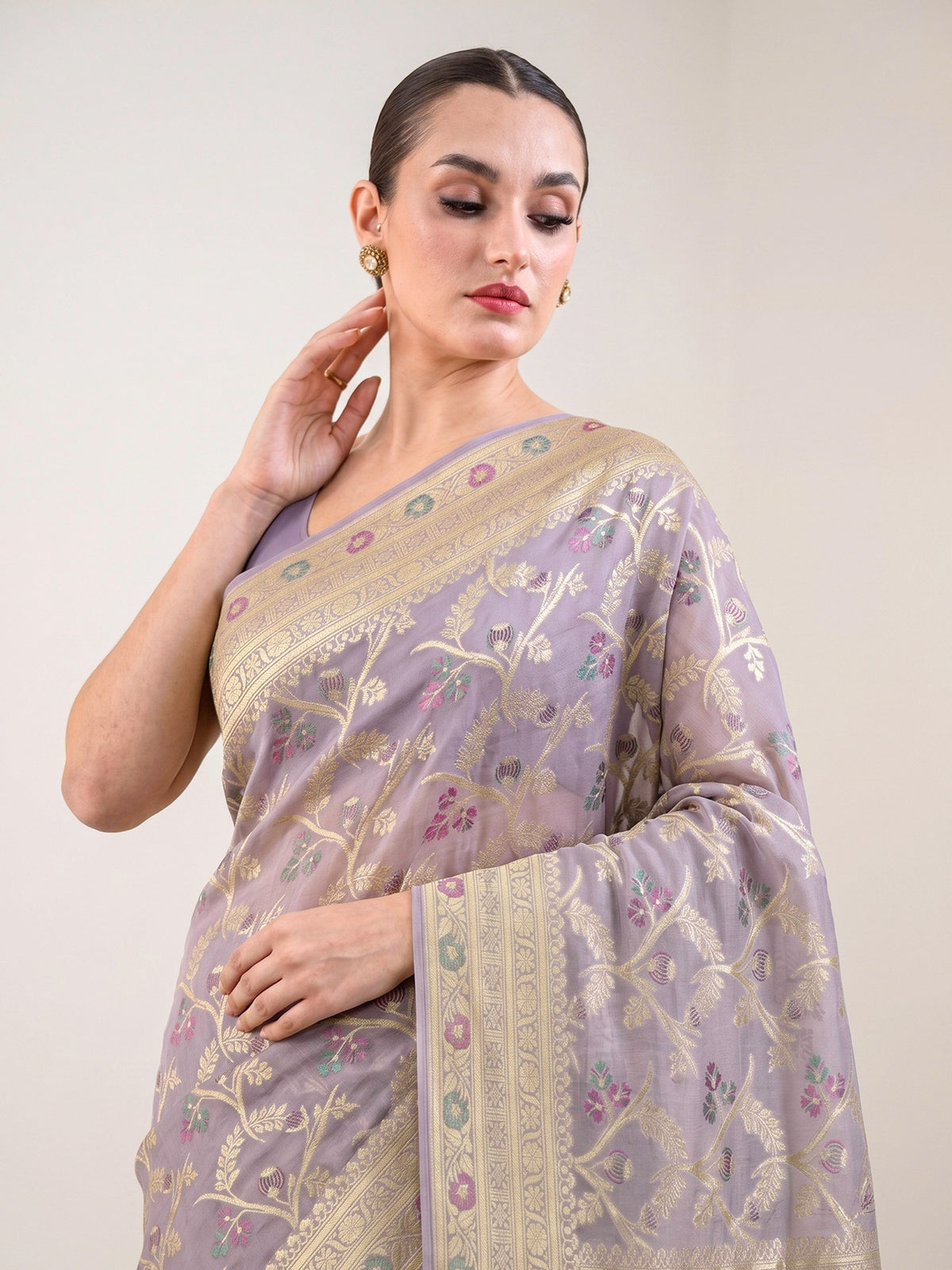
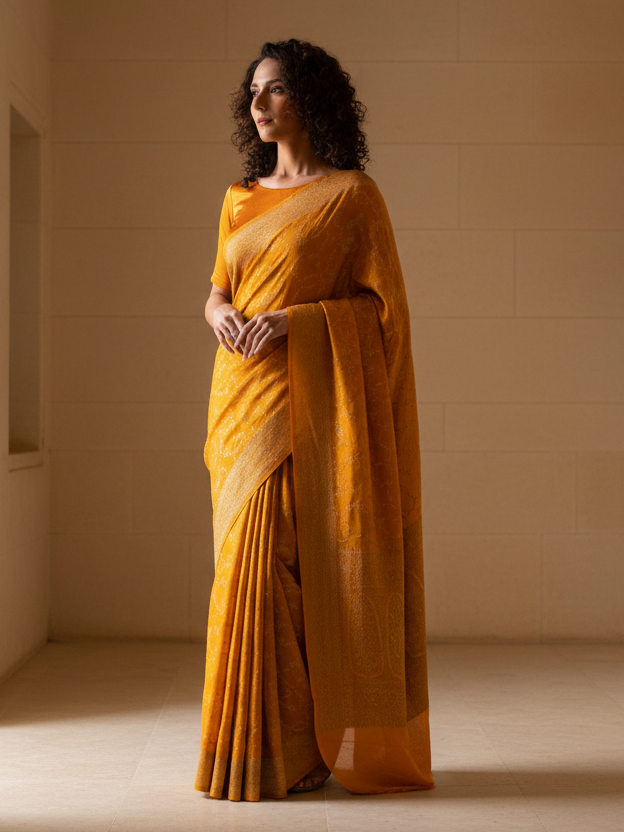
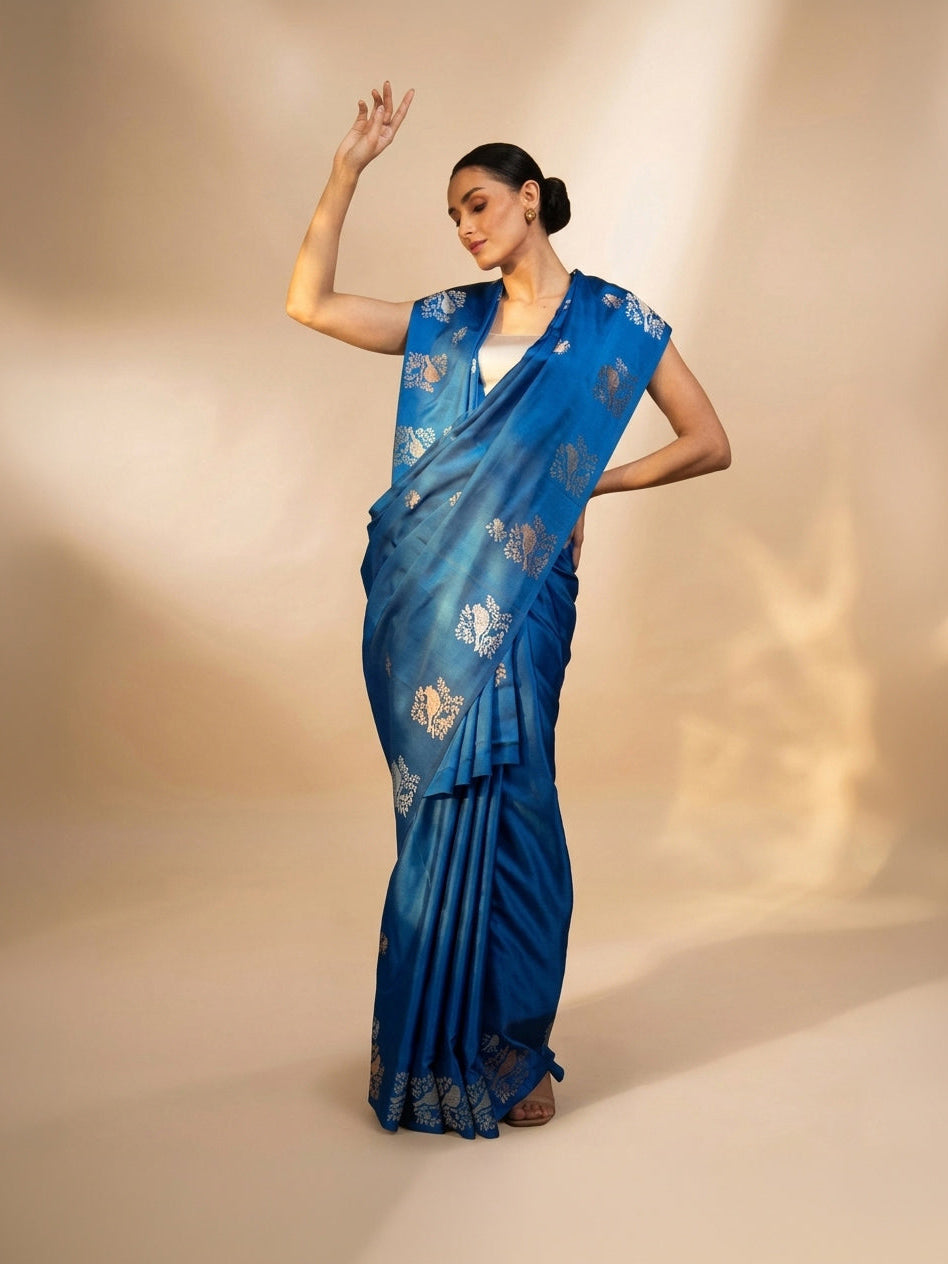
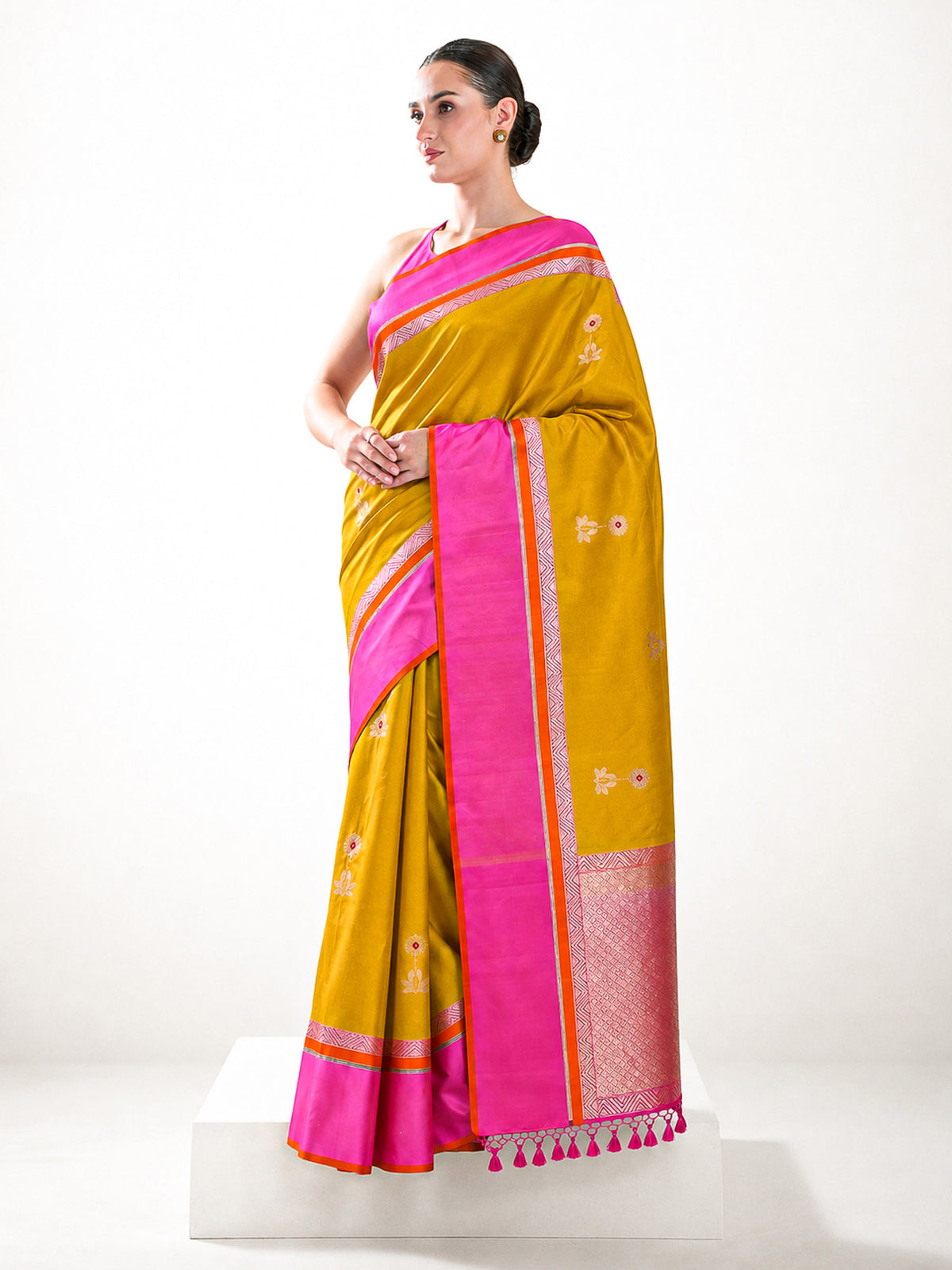

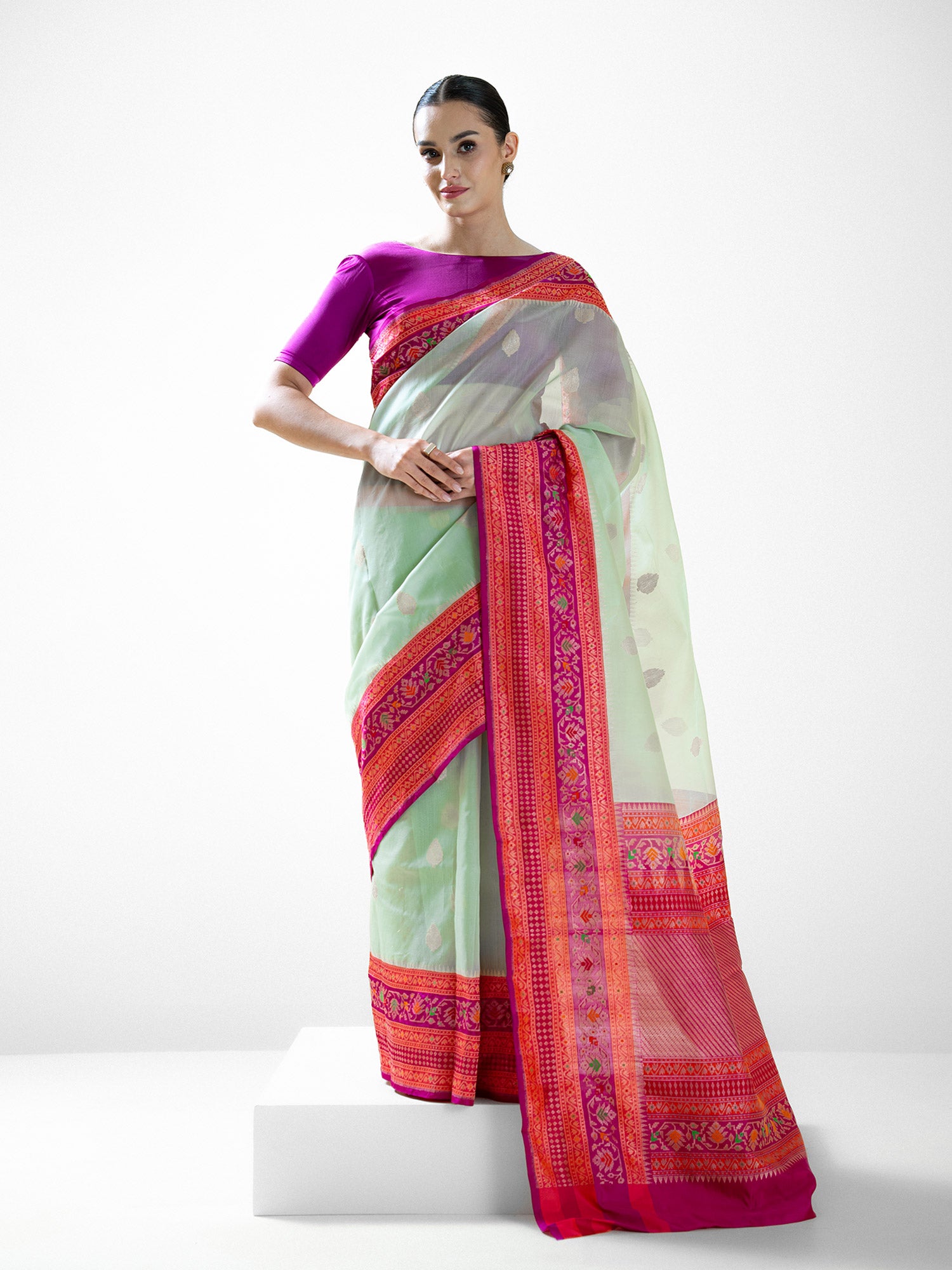
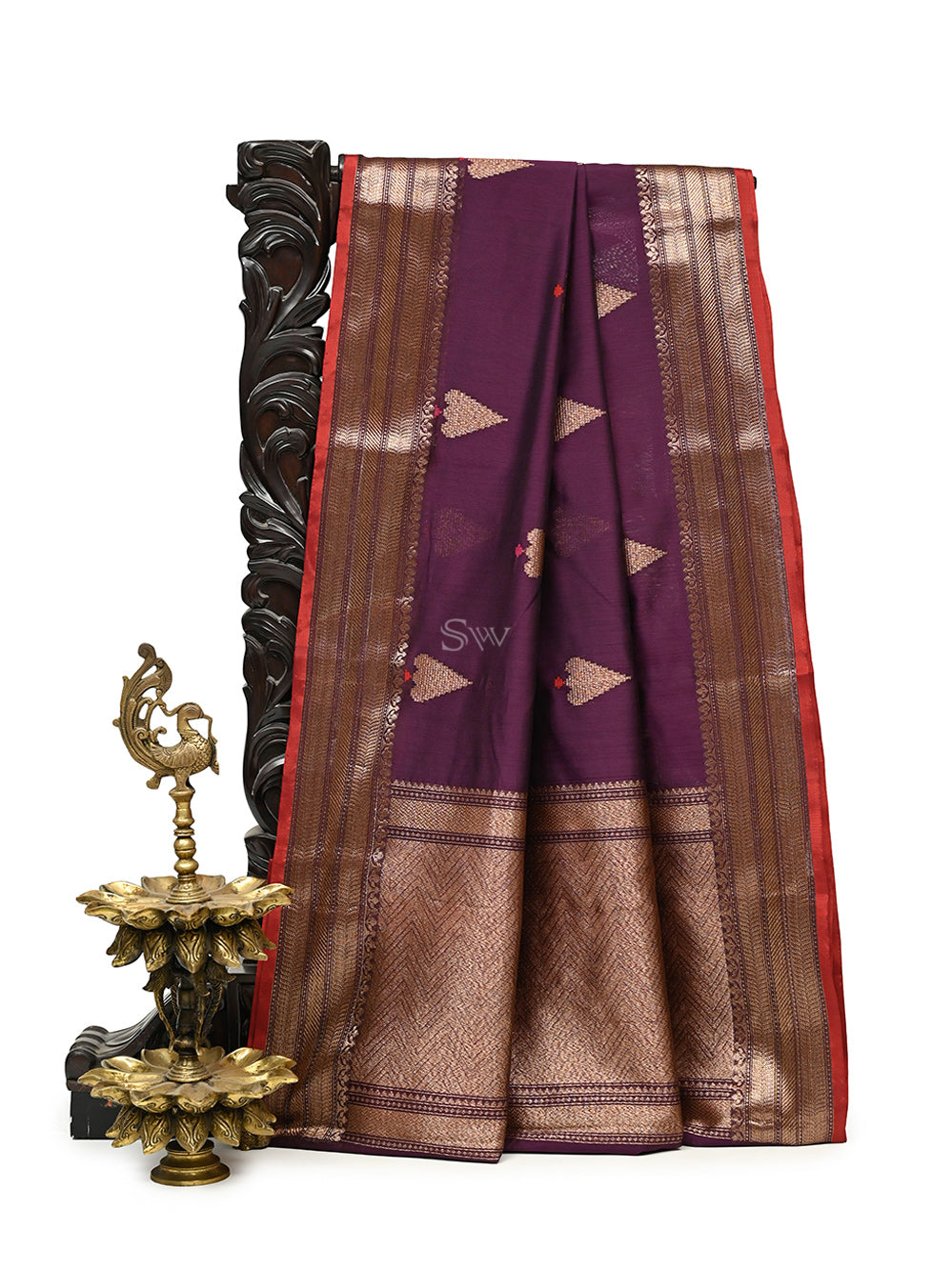


Katan silk is a pure silk fabric made by tightly twisting two or more mulberry silk filaments together before weaving them on a handloom. This twisted yarn — called “katan” in the Varanasi weaving vocabulary — produces a fabric that is smoother, denser, more lustrous, and significantly more durable than any other silk used in Banarasi weaving. When people refer to a “pure Banarasi silk saree” without specifying the fabric, they almost always mean Katan silk. It is the original, the most traditional, and the most valued fabric in the entire Banarasi textile tradition.
If you have ever held a pure Katan silk Banarasi saree in your hands, you know what makes it different before anyone explains it to you. There is a weight to it that feels deliberate. The surface catches light and shifts it — not the flat, uniform shine of synthetic silk, but a deep, living shimmer that changes with every fold and angle. Run your fingers across the body and you feel the density of the weave beneath the smoothness. That is the twisted yarn doing its work — each thread carrying the tension of multiple silk filaments wound tightly around each other.
Whether it is a deep red Katan silk saree for a North Indian wedding or a subtle beige Katan silk for an intimate pooja ceremony, the fabric underneath is the same — pure twisted mulberry silk, handwoven in Varanasi.
This guide covers everything about Katan silk — what it is, where the word comes from, how the fabric is made, what makes it different from other Banarasi silks, the weaving patterns and designs available, how to identify genuine Katan, and why it remains the gold standard for Indian weddings and heirloom collections after centuries of continuous production.
Katan Silk — At a Glance
| Detail | Info |
|---|---|
| Full Name | Katan Silk (also spelled Kataan) |
| Meaning | “Katan” = the process of twisting silk filaments together |
| Fibre | 100% pure mulberry silk |
| Yarn Preparation | Two or more silk filaments twisted tightly together (doubling and twisting) |
| Weave Type | Plain weave — both warp and weft are pure twisted silk |
| Origin | Varanasi (Banaras), Uttar Pradesh, India |
| GI Tag | Yes — Geographical Indication tagged to Varanasi |
| Silk Mark | Certified by Silk Mark Organisation of India |
| Popular Patterns | Booti, Jangla, Tanchoi, Shikargah, Brocade, Rangkat, Plain |
| Weight Range | 600g – 1,200g per saree (varies by zari density) |
| Weaving Time | 15 days to 3+ months depending on design complexity |
| HSN Code | 5007.02 (pure silk fabric) |
| Best For | Weddings, bridal trousseau, receptions, heirloom gifting |
| Price Range | ₹13,000 – ₹1,50,000+ |
What Does “Katan” Actually Mean?
The word “Katan” comes directly from the yarn preparation process. In the weaving workshops of Varanasi, “katan” refers to the act of twisting — specifically, the tight twisting of two or more raw silk filaments around each other to create a single, stronger yarn. The process is called “doubling and twisting,” and it is the foundational step that separates Katan silk from every other fabric woven in Banaras.
Think of it this way: a single silk filament pulled from a cocoon is extraordinarily fine — finer than a human hair. On its own, it is fragile. But when you twist two or three of these filaments together tightly, the resulting yarn becomes something entirely different — strong enough to hold the weight of a dense Jangla pattern with heavy gold zari, smooth enough to create a lustrous surface, and durable enough to last decades without losing its structure.
This is not a marketing name or a brand label. Katan is a technical term that describes exactly how the yarn is made. When a weaver in Varanasi says “yeh katan hai” (this is katan), they are telling you that the silk in your hands is pure, twisted, and prepared in the traditional way. No blends, no shortcuts.
Expert Insight: “The twist is everything. You can take the same mulberry silk and prepare it three different ways — twist it tight for Katan, twist it with a high crepe twist for Georgette, or leave it flat and open for Organza. Same silk, completely different fabrics. That is why just saying ‘pure silk’ is not enough — you need to know how the silk was prepared.” — Sacred Weaves, est. 2017
How Is Katan Silk Fabric Made?
The journey from raw silk cocoon to a finished Katan silk Banarasi saree involves several stages, each requiring a different set of skills. Here is how the process works, step by step.
Stage 1 — Sourcing the raw silk. Pure mulberry silk is sourced — historically from Indian sericulture farms in Karnataka, West Bengal, and Jharkhand. The quality of the raw silk directly affects the final fabric. Premium Katan silk uses high-grade mulberry silk with longer filaments, which produce a smoother, more even yarn after twisting.
Stage 2 — Degumming. Raw silk filaments come coated in sericin, a natural protein that makes the fibre stiff and slightly dull. Degumming removes this coating through a gentle boiling process, revealing the soft, lustrous silk fibre underneath. This is the step that gives silk its characteristic sheen and smoothness.
Stage 3 — Doubling and twisting (the “katan” process). This is the step that defines the fabric. Two or more degummed silk filaments are twisted tightly together on a spinning wheel or twisting frame. The tightness and uniformity of the twist determine the fabric’s final texture — a well-twisted Katan yarn produces a smooth, even surface; an uneven twist creates irregularities that show up in the finished saree. Traditionally, this was done entirely by hand. Today, some workshops use semi-mechanized twisting, but the premium pieces still rely on hand-twisted yarn for the most consistent results.
Stage 4 — Dyeing. The twisted yarn is dyed before weaving — this is called yarn dyeing (as opposed to fabric dyeing, where a finished cloth is dipped in colour). Yarn dyeing is why Katan silk has such deep, saturated colours — whether it is the rich darkness of a black Katan silk saree or the warm earthiness of a brown Katan silk. The dye penetrates every individual filament before the fabric is even woven, which is why these colours hold their depth for decades without fading.
Stage 5 — Setting the loom. The dyed Katan silk warp (vertical threads) is stretched across a pit loom — a traditional handloom where the weaver sits at ground level with legs in a pit to operate the treadles. Setting the warp for a single saree can take an entire day, and the precision of this step determines whether the finished saree will be straight and even or slightly skewed.
Stage 6 — Weaving. The weft (horizontal threads) — also pure twisted silk for the body, and zari (metallic thread) for the motifs — is interlaced with the warp, row by row, to create the fabric. Depending on the design technique, each row may involve throwing multiple shuttles carrying different coloured threads. A simple Booti Katan saree might take 15–20 days. A heavy Kadhua Jangla with dense Meenakari can take 3 months or more.
Stage 7 — Finishing. The finished saree is removed from the loom, inspected for defects, and the loose threads are trimmed. The borders and pallu are checked for alignment. Fall and pico (edging) can be added at this stage.
Expert Insight: “People ask us why handloom Katan silk costs more than powerloom. The answer is simple — a powerloom can produce a saree body in hours. A handloom takes weeks. But the hand-woven fabric has a character that no machine can replicate. The slight give in the weave, the way the silk breathes, the way the zari settles into the fabric — these come from the weaver’s hands, not from a motor.” — Sacred Weaves, est. 2017
Katan Silk Saree Weaving Patterns and Designs
Not all Katan silk sarees look the same — the pattern and weaving technique determine the visual character, the weight, the weaving time, and ultimately the price. Here are the major patterns you will find in Banarasi Katan silk sarees today.
Booti (Buti)
Booti Katan silk sarees feature small, individual motifs scattered across the body of the saree — floral sprigs, paisleys, or geometric shapes repeated at regular intervals. Booti is the most common and accessible Katan silk design. The spacing between motifs means less zari, which makes these sarees lighter (600–750g) and more affordable. They are an excellent entry point for someone buying their first genuine Katan silk saree — all the fabric quality, without the bridal-level weight or price.

Jangla / Jaal
Jangla — also called Jaal — covers the entire body of the saree in a continuous, interlocking lattice of motifs. There is no blank space; the design is wall-to-wall. This is the heaviest and most elaborate pattern in Banarasi weaving. A Kadhua-woven Jangla Katan silk saree can take 500–800+ hours on the handloom and weigh 1,000–1,200g. These are the showstopper bridal sarees — the ones that stop conversations when a bride walks in. Available across colours, but the classic purple Katan silk saree with gold Jangla and the green Katan silk with silver Jangla remain perennial bestsellers.

Tanchoi
Tanchoi is a distinguished Banarasi weaving technique known for its intricate silk-on-silk weaving. It is woven using fine resham (silk) yarns in both the warp and weft, creating a fabric that is exceptionally smooth on both sides. Multiple coloured silk threads are carefully woven together to form elegant contemporary designs, jaal, bel, floral motifs, and paisley patterns. Together, it showcases the finesse and timeless craftsmanship of Banaras weavers. Every Tanchoi Banarasi Saree is a timeless heirloom, treasured for its beauty, artistry, and enduring elegance.
Shikargah
Shikargah literally translates to “hunting ground.” These sarees feature elaborate scenes of animals, birds, trees, and hunting processions woven in brocade — elephants marching, deer leaping, peacocks perching on mango trees. The motifs are rooted in Mughal court art, and each Shikargah saree tells a visual story. These are among the most collectible Katan silk designs — favoured by saree collectors and women who want a talking piece, not just a garment.

Brocade
Brocade refers to any Katan silk saree where supplementary zari threads are woven into the fabric to create raised, textured patterns. The motifs sit on top of the base weave, giving brocade sarees their characteristic three-dimensional feel. Heavy brocade work in gold Katan silk is the traditional choice for North Indian weddings — the raised gold zari against deep-coloured silk creates the regal effect that Banarasi sarees are famous for.

Rangkat
Rangkat is one of the most intricate and artistic Banarasi weaving techniques, admired for its seamless blend of multiple colours within a single fabric. The colours are woven directly into the saree by carefully interlocking different coloured silk yarns on the loom. This highly skilled technique creates beautiful colour transitions, geometric layouts, stripes, checks, and artistic patterns with remarkable precision. Every Rangkat Banarasi Saree is a timeless heirloom that reflects the exceptional craftsmanship, patience, and rich weaving heritage of Banaras.

Plain Katan Silk
Not every Katan silk saree has elaborate zari work. Plain Katan silk sarees have minimal or no motifs on the body — the beauty comes entirely from the fabric itself, with the lustre, drape, and depth of colour doing the talking. These are the lightest Katan silk sarees (550–650g), ideal for daily festive wear, office celebrations, and intimate gatherings. A grey Katan silk in plain weave or an off-white plain Katan can be dressed up or down depending on the blouse and jewellery you pair it with.
What Makes Katan Silk Different From Other Banarasi Fabrics?
Banarasi is a weaving tradition, not a single fabric. Varanasi’s weavers work with several different silk types, and each produces a distinctly different saree. Understanding what separates Katan from the rest helps you choose the right fabric for your occasion.
| Feature | Katan Silk | Khaddi Georgette | Organza (Kora) | Crepe Silk | Tissue |
|---|---|---|---|---|---|
| Yarn Twist | Tight, uniform twist | High crepe twist | Flat, open twist | Medium twist | Silk + zari blend |
| Feel | Smooth, structured, medium-firm | Soft, fluid | Crisp, lightweight, airy | Smooth, flowy | Lightweight, shimmer |
| Weight | 600–1,200g | 400–650g | 450–650g | 550–800g | 500–800g |
| Drape | Holds pleats, structured | Comfortable | Stands away from body | Holds pleats, comfortable | Light, structured |
| Best For | Weddings, bridal, formal | Parties, daytime, daily festive | Summer weddings, mehendi | Festivals, all-day wear | Evening events, sangeet |
The key distinction is this: Katan silk is the only Banarasi fabric that can hold the heaviest, most intricate zari work without distorting. A Kadhua Jangla pattern with dense gold zari weighing 400–500 grams needs a base fabric strong enough to support it — and twisted Katan silk yarn is that base. This is why virtually every bridal Banarasi saree worth investing in is woven on Katan silk.
Most Popular Banarasi Katan Silk Sarees by Colour
Colour choice in a Katan silk saree is rarely random — it often carries cultural meaning, seasonal relevance, or personal significance. Here is what sells and why.
Red Katan silk sarees remain the unchallenged leader for bridal wear across North India. Red with gold zari Jangla or Kadhua — that combination has defined Indian weddings for generations. Maroon and wine offer deeper, more contemporary alternatives for brides who want the traditional colour family without the classic bright red.
Black Katan silk sarees have become a reception favourite in recent years — a trend driven by Bollywood and social media. Black with gold Shikargah brocade or a black Tanchoi looks undeniably dramatic under evening lights.
Green Katan silk — from bottle green to pista green — is the second most popular bridal colour after red, especially in Bengali and Bihari wedding traditions. Pink and Purple are favoured for trousseau pieces — the sarees a bride wears to post-wedding events and festivals.
For festive occasions outside of weddings, mustard and orange Katan silk sarees are popular for haldi and mehndi ceremonies. Pink, peach, and cream are increasingly chosen by modern brides for daytime wedding ceremonies and destination weddings.
Neutral tones like beige, brown, grey, and gold work beautifully for intimate gatherings, pooja ceremonies, and buyers who want a Katan silk saree they can wear to multiple occasions without it being “the wedding saree.”
Browse the full colour range in our Banarasi Katan silk saree collection.
The History of Katan Silk Weaving in Varanasi
Silk weaving in Varanasi has roots that stretch back to at least the 14th century, though some historians trace the tradition even further. The craft took its most recognisable form during the Mughal era (16th–18th centuries), when Persian textile influences merged with local Indian weaving knowledge under royal patronage. The Mughal courts of Delhi and Agra had an insatiable appetite for fine silk brocades, and Varanasi — already a centre of trade and pilgrimage — became the primary supplier.
The motifs that define Banarasi Katan silk today carry this dual heritage clearly. The jaal (lattice) patterns, the paisley, the floral scrollwork — these trace back to Persian garden art. The Shikargah hunting scenes reflect Mughal court life. The lotus, the peacock, the temple border — these are rooted in Hindu artistic traditions. The genius of Varanasi’s weavers was in fusing these two visual languages into a single, coherent aesthetic that felt neither entirely Mughal nor entirely Hindu, but distinctly Banarasi.
By the 18th century, Katan silk had established itself as the premier fabric for Indian bridal wear across North India. A bride wearing Banarasi Katan silk was — and still is — a cultural statement as much as a fashion choice.
In 2009, Banarasi sarees — including Katan silk — received a GI (Geographical Indication) tag, legally protecting the craft and confirming that a genuine Banarasi saree must be woven in Varanasi.
How to Identify Genuine Pure Katan Silk
With the market flooded by machine-made imitations and synthetic blends labelled as “Banarasi,” knowing how to identify genuine Katan silk is essential — especially when you are spending ₹20,000 or more on a single saree. We have written a detailed guide on this topic: How to Recognize Pure Katan Silk Banarasi Handloom Saree. Here is a summary of the key tests.
The touch test. Hold the fabric between your fingers. Pure Katan silk feels smooth, warm, and dense. There is a natural weight to it that you feel immediately. Art silk (synthetic) feels cold, slippery, and suspiciously light. Semi-Katan — which mixes silk with other fibres — feels close but lacks the density and warmth of a fully twisted pure silk.
The burn test. Pull a single thread from the edge and burn it. Pure silk smells like burning hair (it is a protein fibre), leaves a crushable ash, and stops burning once the flame is removed. Synthetic fibres melt, form hard beads, and smell like burning plastic.
Silk Mark certification. The most straightforward verification. The Silk Mark Organisation of India certifies sarees as 100% pure natural silk after laboratory testing. Every Katan silk saree at Sacred Weaves carries a Silk Mark certificate verifiable at silkmarkindia.com.
HSN Code. Check the purchase invoice. Pure silk sarees are billed under HSN Code 5007. If the HSN code is different, the fabric classification is not pure silk.
Katan Silk vs Semi Katan Silk — What Is the Difference?
This is one of the most common points of confusion in the market, and it matters because the price difference is significant.
Pure Katan silk uses twisted pure mulberry silk in both the warp (vertical threads) and the weft (horizontal threads). Every thread in the fabric is 100% silk. This is what earns the Silk Mark certification and the HSN Code 5007 classification.
Why Katan Silk Sarees Cost More — And Why They Are Worth It
Katan silk sarees are not cheap, and there is no honest way to pretend otherwise. A genuine handloom Katan silk Banarasi saree starts around ₹13,000–₹15,000 for the simplest Booti designs and can cross ₹1,50,000 for heavy Kadhua Jangla bridal pieces. Here is why.
The raw material is pure silk. Mulberry silk is one of the most expensive natural fibres in the world.
The yarn preparation is labour-intensive. Doubling and twisting silk filaments — the katan process itself — is an additional step that lighter fabrics skip. This adds time and cost before the weaving even begins.
The weaving time is measured in weeks and months, not hours. A simple Booti takes 15–20 days. A Tanchoi takes 3–4 weeks. A Shikargah brocade takes 4–6 weeks. A Kadhua Jangla bridal saree can take 3 months. The weaver is paid for every day of that work, as they should be.
The skills are generational. Master weavers in Varanasi have trained for decades. The Kadhua technique — weaving each motif individually without floating threads — is a skill that takes years to learn and a lifetime to master. You are not just paying for silk and metal — you are paying for knowledge that has been refined over centuries.
The result is a saree that lasts decades, often gets passed down as a family heirloom, and gains sentimental and textile value over time. A well-maintained Katan silk Banarasi saree from the 1970s or 1980s is not just wearable today — it is often more beautiful than new, because the silk has softened and the zari has developed an age.
How to Care for a Katan Silk Saree
A Katan silk saree that is cared for properly will outlast you. Here is what we recommend — and what we tell our own family.
Store the saree wrapped in a soft muslin or cotton cloth — never in plastic. Plastic traps moisture, and moisture is the enemy of both silk and zari. Refold the saree every 3–4 months along different crease lines to prevent permanent fold marks. If you use mothballs, keep them wrapped separately — direct contact with neem or camphor can stain silk.
Dry clean only when genuinely necessary — not after every wear. After each use, simply air the saree on a padded hanger for a few hours to let body moisture evaporate before folding and storing. Most Katan silk sarees need dry cleaning only once every 2–3 years unless they are stained.
Never iron directly on the silk surface. Use a cotton pressing cloth as a barrier, and keep the iron on a low silk setting.
Keep the saree away from perfume, deodorant, and any alcohol-based spray. These can permanently stain both the silk and the zari.
And one thing that surprises most first-time Katan silk buyers: a brand-new saree will feel stiffer than expected. This is normal. Pure Katan silk relaxes with wear — by the 2nd or 3rd drape, the fabric softens noticeably and conforms to your body’s natural movements. Do not wash or treat a new Katan saree to “soften” it. Just wear it. The silk knows what to do.
Where to Buy Pure Katan Silk Saree Online
Finding genuine Katan silk online requires a bit of diligence — the market has no shortage of sellers labelling machine-made sarees as “Banarasi handloom.” We have written a full guide on this: Where to Buy Pure Katan Silk Banarasi Saree. Here is what to look for in a nutshell.
Buy from sellers who are also manufacturers or have direct relationships with weaving workshops in Varanasi — not resellers who cannot tell you where the saree was actually made. Ask for Silk Mark certification. Check the HSN Code on the invoice. And if the seller offers live video shopping — as we do at Sacred Weaves — use it. Seeing a Katan silk saree draped in real time, watching the zari catch light, and having someone show you the reverse side of the weave answers more questions than any product photo ever can.
At Sacred Weaves, every Katan silk saree is Silk Mark certified and handwoven on pit looms in Varanasi. We ship worldwide with duties prepaid (DDP) and offer custom blouse stitching with every purchase.


