

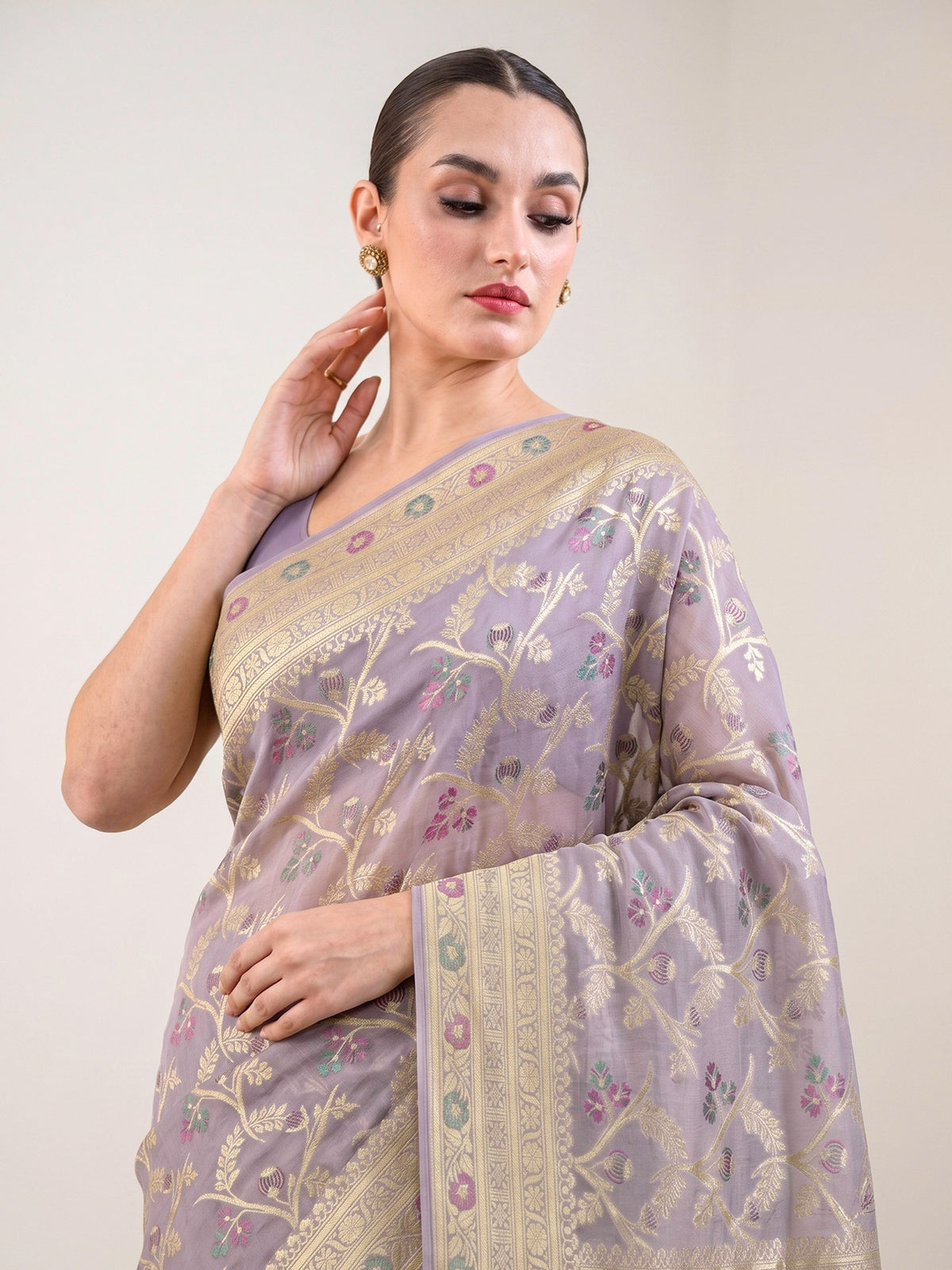
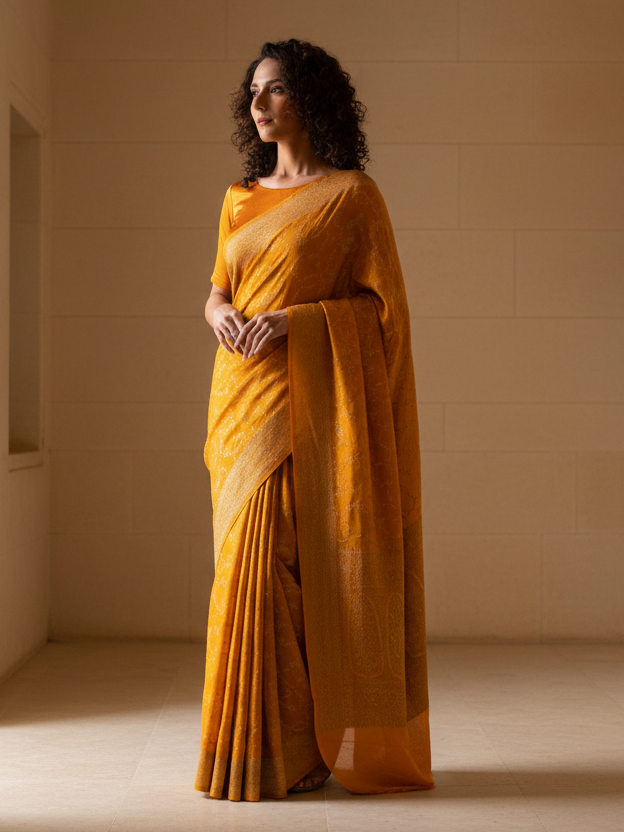
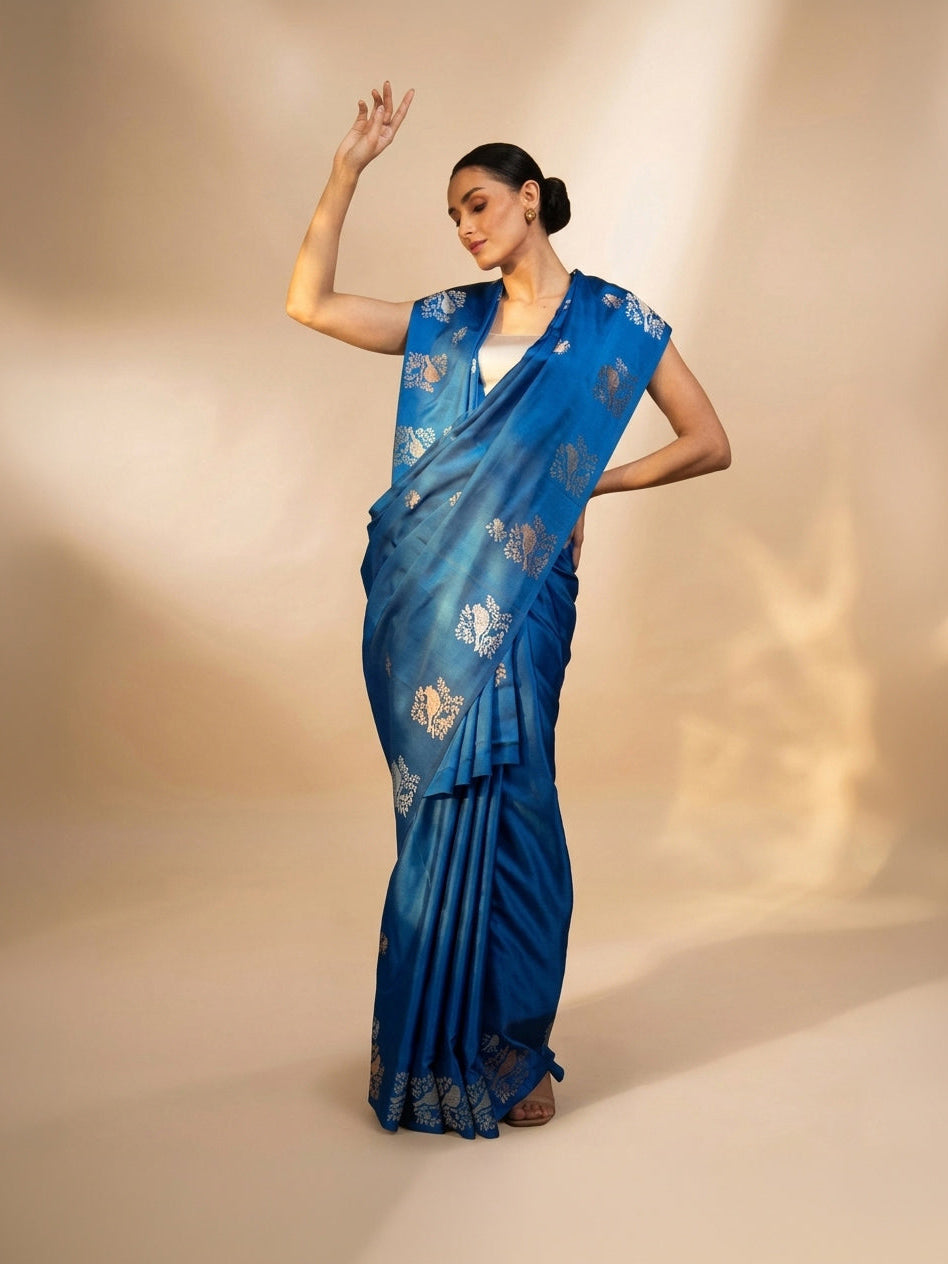
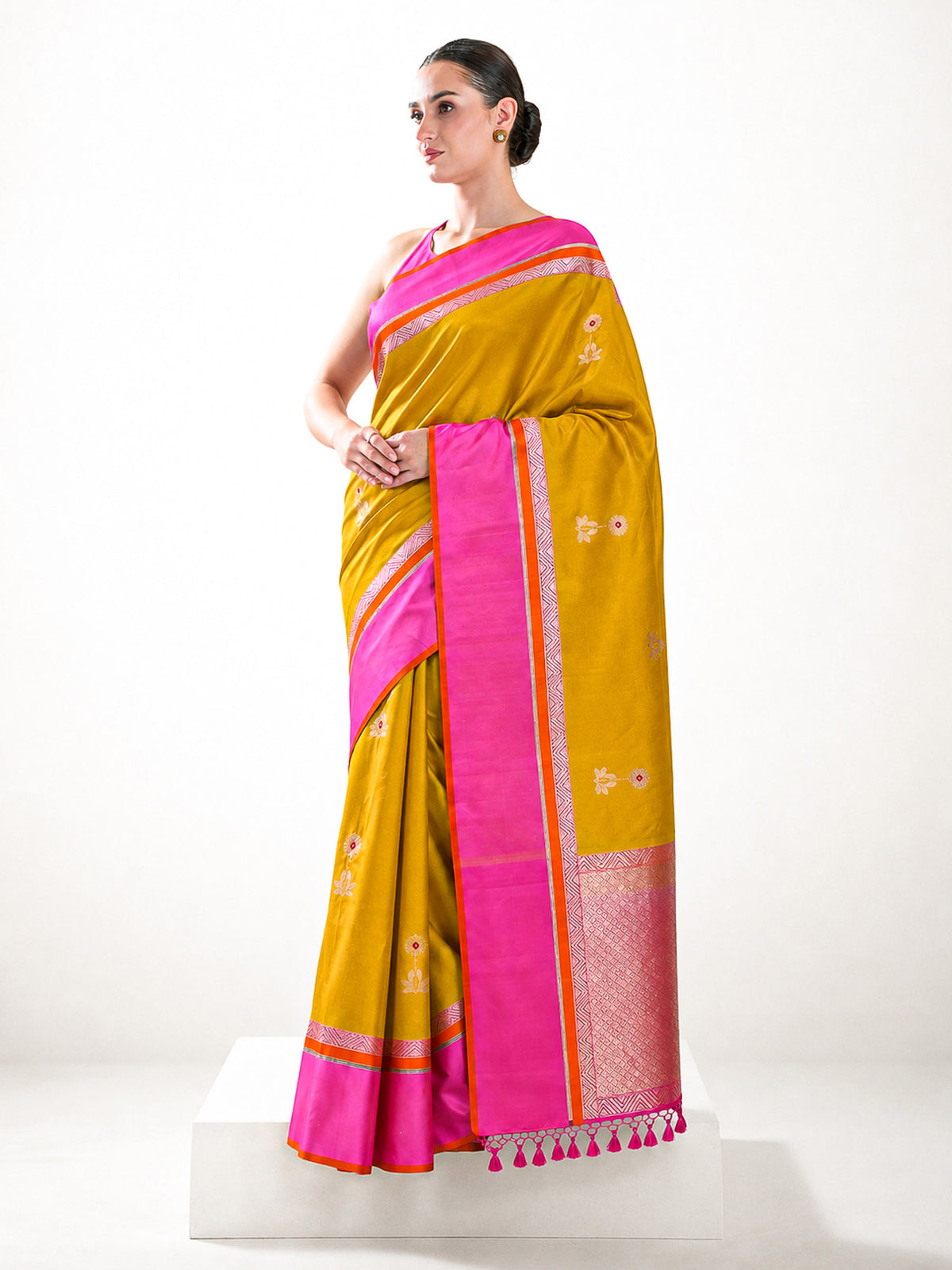

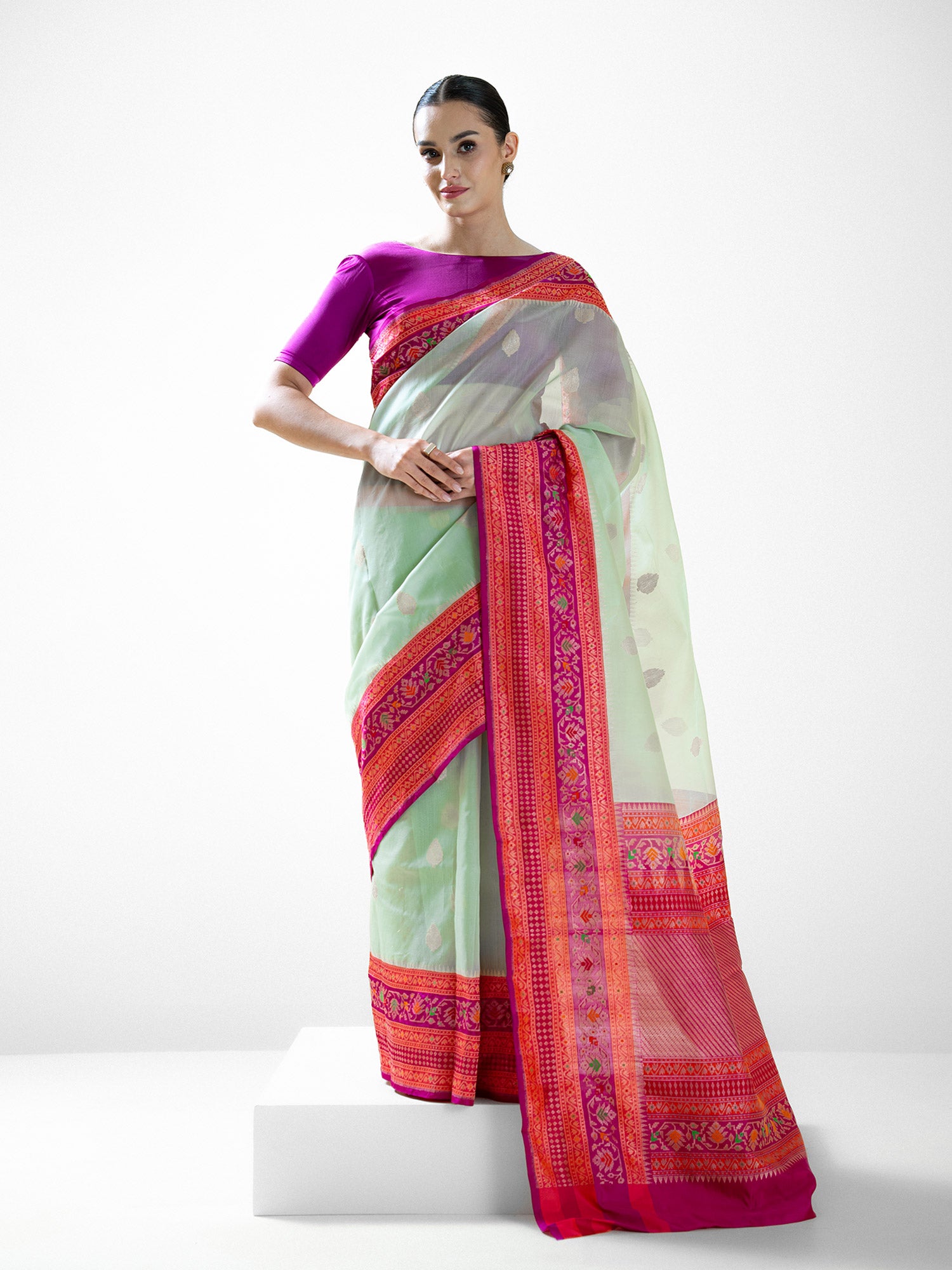
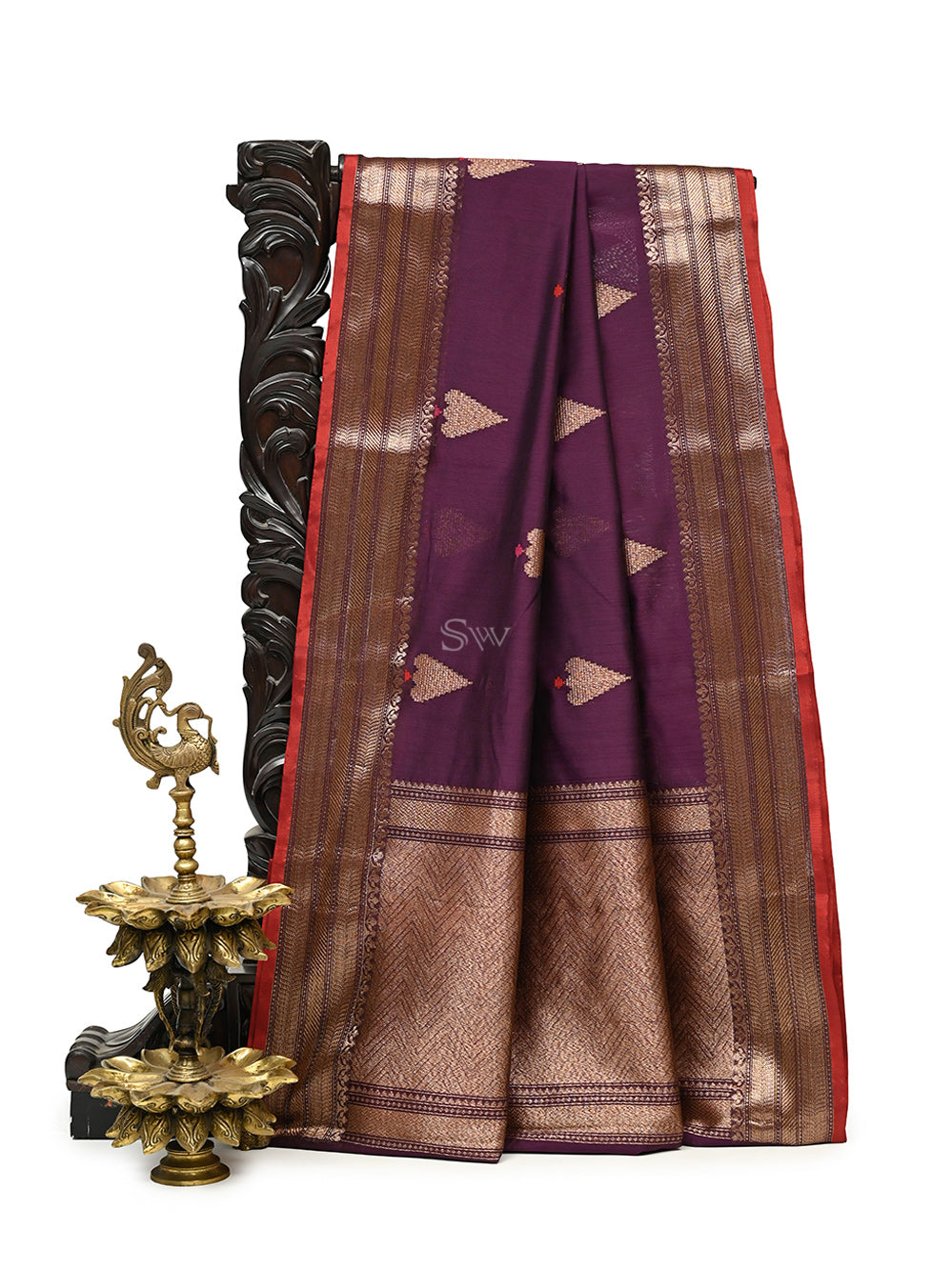


If you have ever touched a Katan Banarasi saree, you may have noticed that it feels different from lighter sarees such as Organza or Georgette. It has a rich body, a smooth silk surface, and a graceful fall that gives it a distinctly traditional appearance.
This often leads to one simple question:
Is Katan Silk soft or stiff?
The answer is slightly more nuanced than simply calling it soft or stiff.
Katan Silk is generally smooth, rich, and comfortable, but it has a more structured body than lightweight Banarasi fabrics. It is not naturally stiff like a synthetic fabric, but a heavily woven Katan saree can feel firm or substantial, especially when it contains dense zari, intricate motifs, or a heavier weave.

This is also why some women describe Katan as “soft silk” while others feel that it is comparatively heavy or structured.
The actual feel depends on several factors, including the silk quality, weave density, zari work, weaving technique, and design.
If you are planning to buy a soft Katan silk saree, understanding these differences can help you choose the right saree instead of judging it only from photographs.
What Does Katan Silk Feel Like?
Katan Silk is known for its smooth, rich texture and natural silk lustre.
When you run your fingers across a good-quality Katan saree, it generally feels smooth but not excessively slippery. Pure silk has a natural texture that is different from the perfectly uniform feel often found in synthetic fabrics.
The reference material describes Pure Katan Silk as having a rich texture, natural sheen, and structured drape. It is also highlighted as a suitable base for highly intricate Banarasi motifs because of its dense weave.
This gives Katan its characteristic personality:
- Smooth surface
- Rich silk feel
- Natural sheen
- Structured drape
- Good body
- Comfortable when made from quality silk
- Ability to support detailed weaving
So, if you are asking “is Katan Silk soft?”, the answer is yes, it can be soft and smooth, but it is not usually as fluid or lightweight as fabrics such as Georgette or Organza.
Is Katan Silk Soft?
Yes, Katan Silk can be soft, particularly when it is made from good-quality natural silk and finished properly.
However, “soft” does not necessarily mean “light” or “flowy”.
This is where many buyers become confused.
A Katan saree can feel soft against the skin while still having a firm and structured body. Think of the difference between a soft cotton shirt and a soft silk fabric with more body—the material can be comfortable to touch without losing its structure.
Pure silk itself is known for its smooth and soft feel. The reference material also explains that pure silk generally feels soft, smooth, and warm to the touch, while artificial silk may feel slippery, stiff, or synthetic.
Therefore, a soft Katan silk saree should ideally feel:
- Smooth rather than rough
- Rich rather than plastic-like
- Soft rather than harsh
- Naturally lustrous rather than excessively glossy
- Comfortable rather than synthetic
But the overall weight and fall of the saree can still be substantial.
Why Does Katan Silk Sometimes Feel Stiff?
A Katan saree may feel comparatively stiff or firm because of its weave and construction, not necessarily because the silk itself is stiff.
Several factors can influence this.
1. Dense Weave
Katan is commonly used for detailed Banarasi weaving. A denser weave gives the fabric more body.
The reference material specifically notes that dense fabrics such as Pure Katan Silk comfortably accommodate highly intricate motifs such as Shikargah and elaborate Kalga.
This density can make the saree feel more structured.
2. Heavy Zari
A saree with extensive zari work will naturally feel heavier and more substantial than a simple Katan saree.
A rich zari border, dense pallu, or all-over brocade can significantly change how the saree feels in your hands.
3. Intricate Weaving
Kadwa, Meenakari, Jangla, Shikargah, and other complex designs require more weaving work.
The more densely woven the design, the more body the finished saree may have.
4. Finishing
Finishing processes can also affect how a saree feels when new.
A newly purchased saree may initially feel more structured and gradually become more comfortable and supple with use and proper care.
Is Katan Silk Heavy?
This is another common question:
“Is Katan Silk heavy?”
Katan itself should not be judged simply as a heavy fabric.
The weight of a Katan saree depends on its construction.
A relatively simple Katan saree can feel quite manageable, while a heavily woven bridal Katan with dense zari and elaborate motifs can be considerably heavier.
The reference material makes an important point here: the value and character of a Banarasi saree depend on factors such as fabric, weaving technique, motif complexity, zari quality, and craftsmanship.
So when someone says “Katan is heavy,” they may actually be describing a heavy Katan Banarasi design, rather than the Katan fabric itself.
Understanding Katan Silk Weight
There is no single fixed Katan Silk weight that applies to every saree.
This is because saree weight can vary according to:
- Saree length
- Fabric density
- Silk yarn
- Weaving technique
- Zari quantity
- Motif density
- Border size
- Pallu design
- Overall construction
For example, a plain or lightly decorated Katan saree can feel much easier to carry than an elaborate bridal saree featuring a dense zari body and heavily woven pallu.
This is why buyers should not ask only:
“How many grams does the saree weigh?”
A better question is:
“What is the fabric construction and how much zari and weaving work does it contain?”
The answer will give you a much better idea of how the saree will actually feel when worn.
Soft Katan Silk Saree vs Lightweight Banarasi Fabrics
Katan can be soft, but it should not be compared directly with lightweight fabrics because they have different characteristics.
| Fabric | Feel | Drape | Overall Character |
|---|---|---|---|
| Katan Silk | Smooth, rich, structured | Graceful and structured | Traditional and luxurious |
| Organza | Crisp and lightweight | Structured but light | Elegant and contemporary |
| Georgette | Soft and fluid | Flowing | Lightweight and comfortable |
| Tissue | Smooth with luminous finish | Structured | Festive and luxurious |
| Mashru Satin Silk | Smooth and soft | Fluid | Satin-like and comfortable |
This is why a woman who wants a very lightweight saree may not find Katan as easy to carry as Georgette.
But a woman who wants a rich traditional Banarasi saree with a soft silk feel and structured drape may find Katan ideal.
Is Katan Silk Comfortable to Wear?
Yes, a good-quality Katan Silk saree can be very comfortable.
Natural silk is known for its smooth feel and breathability, and pure silk fabrics are valued in India for their rich texture and comfort across seasons.
However, comfort depends on more than the fibre.
A very heavily woven bridal Katan saree with dense zari will naturally feel different from a simple Katan saree with minimal decoration.

Katan Silk Handloom Banarasi Saree
For example:
Simple Katan + light zari = easier and lighter feel
Dense Katan + heavy zari + elaborate pallu = richer and heavier feel
Therefore, if you want a saree that you can wear for several hours, consider both the fabric and the amount of decorative weaving.
How Does a Soft Katan Saree Drape?
A soft Katan saree generally falls gracefully while still maintaining some structure.
This creates a very different look from a highly fluid fabric.
The pleats tend to hold their shape well, while the pallu can create a rich and elegant fall.
This is particularly useful for traditional Indian draping because the saree does not simply collapse around the body.
The structured character also helps showcase:
- Zari borders
- Floral motifs
- Buta designs
- Meenakari work
- Jangla patterns
- Elaborate pallus
The reference material specifically notes that Katan's rich texture, natural sheen, and structured drape allow intricate weaving details to stand out beautifully.
Does Heavy Katan Mean Better Katan?
No.
This is an important point for buyers.
Heavier does not automatically mean better.
A saree can be heavier because it contains more zari or a denser design, but that does not automatically mean the silk quality is superior.
Similarly, a lighter Katan saree can still be made from high-quality silk and excellent craftsmanship.
The actual value of a Banarasi saree comes from the combination of:
- Silk quality
- Weaving technique
- Artisan expertise
- Motif complexity
- Zari quality
- Production time
- Finishing
- Authenticity
The reference material makes the same distinction when discussing Banarasi saree pricing: price should not be judged by one feature alone, but by the combination of materials, craftsmanship, weaving technique, and artistic complexity.
How to Tell If Katan Feels Like Real Silk?
If you are shopping for a Katan saree, pay attention to the feel, but do not rely on touch alone.
Pure silk generally has:
- A soft and smooth texture
- Natural warmth when held
- A subtle, changing lustre
- A rich rather than plastic-like feel
Synthetic fabrics may feel uniformly slippery or unusually glossy.
However, even experienced buyers can find it difficult to identify silk only by touch. The reference material specifically recommends looking at certification and other authenticity indicators rather than relying only on feel.
If you are making a significant investment, ask whether the saree is made from 100% natural silk and look for appropriate Silk Mark certification where applicable.
Soft Katan Saree vs Heavy Bridal Katan
The word “Katan” covers a wide range of sarees.
A soft Katan saree may feature:
- Fine silk
- Light zari
- Smaller motifs
- Less dense weaving
- A simpler border
- A relatively lighter pallu
A heavy bridal Katan may feature:
- Dense silk weaving
- Heavy zari
- Large motifs
- Elaborate pallu
- Broad border
- Meenakari or other detailed work
- More complex weaving techniques
Therefore, when shopping online, do not simply search for “Katan Silk” and assume every result will have the same feel.
Ask the seller for:
Fabric composition + saree weight + weaving technique + zari details + close-up video
This gives you a much more realistic understanding of what you are buying.
Expert Insight
One of the biggest misconceptions about Katan Silk is that it must be either completely soft or completely stiff.
The reality is somewhere in between.
Good Katan Silk has softness and structure at the same time.
Its silk fibres can feel smooth and comfortable, while its dense weave and Banarasi craftsmanship can give the saree a firm body.
This is exactly why Katan is so popular for traditional Banarasi sarees. It can feel luxurious against the skin while also holding intricate motifs and creating the structured drape that many women associate with a classic Banarasi bridal saree.
How to Choose the Right Katan Silk Based on Weight and Feel
Before buying, think about how you actually plan to wear the saree.
| If You Want… | Look For… |
|---|---|
| Soft and comfortable Katan | Fine silk, lighter weaving and moderate zari |
| Traditional bridal look | Rich Katan with detailed zari and structured drape |
| Lightweight festive saree | Lighter Katan construction and minimal zari |
| Heirloom saree | High-quality silk with traditional handloom craftsmanship |
| Easy-to-carry saree | Lower motif density and lighter zari |
| Grand wedding saree | Dense weaving, elaborate pallu and rich border |
| Rich traditional appearance | Structured Katan with detailed Banarasi motifs |
If you are unsure, ask the seller to show the saree being draped or moved on camera.
This is particularly useful when buying online because photographs cannot always communicate fabric weight and movement accurately.
Common Myths About Katan Silk Feel and Weight
Myth 1: Katan Silk Is Always Stiff
Reality: Katan can be soft and smooth while still having a structured body. The actual feel depends on silk quality, weave density, zari, and construction.
Myth 2: Soft Katan Means Lightweight Katan
Reality: Softness and weight are different characteristics. A saree can feel soft while still being relatively heavy because of dense weaving or zari.
Myth 3: Heavy Katan Means Better Quality
Reality: Weight alone does not determine silk quality or craftsmanship. Zari, weaving technique, silk quality, and motif complexity also influence the saree's weight and value.
Myth 4: Every Katan Banarasi Has the Same Drape
Reality: Different Katan sarees can have different drapes depending on their weave, silk yarn, zari, design density, and finishing.
Myth 5: You Can Confirm Pure Silk Just by Touching It
Reality: Touch can provide useful clues, but it cannot conclusively prove silk purity. Certification and seller transparency are more reliable when making a premium purchase.
Final Thoughts
So, is Katan Silk soft?
Yes. A good-quality Katan Silk can feel smooth, soft, and luxurious.
But is Katan Silk completely fluid and lightweight like Georgette?
No.
Katan has a naturally richer and more structured character, particularly when it is woven densely or combined with elaborate zari and traditional Banarasi motifs.
Similarly, is Katan Silk heavy?
It can be, but the weight depends on the complete construction of the saree. Silk quality, weave density, zari, motif complexity, border, and pallu all contribute to the final Katan Silk weight.
This is why the best Katan saree is not necessarily the softest or the heaviest one.
It is the one that gives you the balance you want between comfort, structure, richness, and craftsmanship.
For a traditional bridal saree, a rich and structured Katan can create the regal appearance many brides want. For festive or regular occasions, a softer and lighter Katan construction may be easier to carry.
Ultimately, understanding how Katan actually feels helps you shop with much more confidence. Instead of asking only whether the saree looks beautiful, ask how it feels, how it drapes, how much zari it contains, how it was woven, and whether the silk is authentic.
That is what allows you to choose a Katan saree that is beautiful not only in photographs, but also when you actually wear it.


