
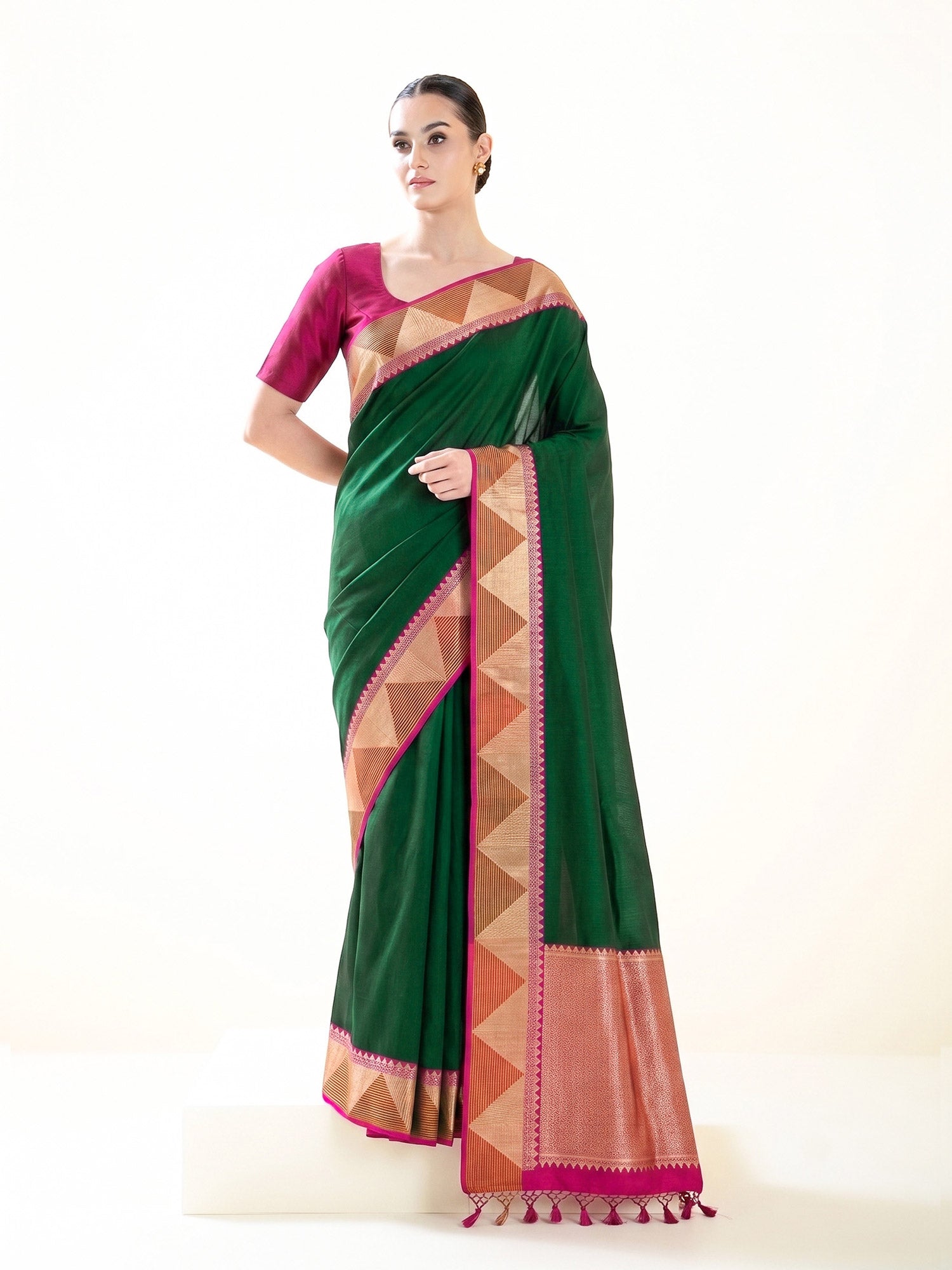

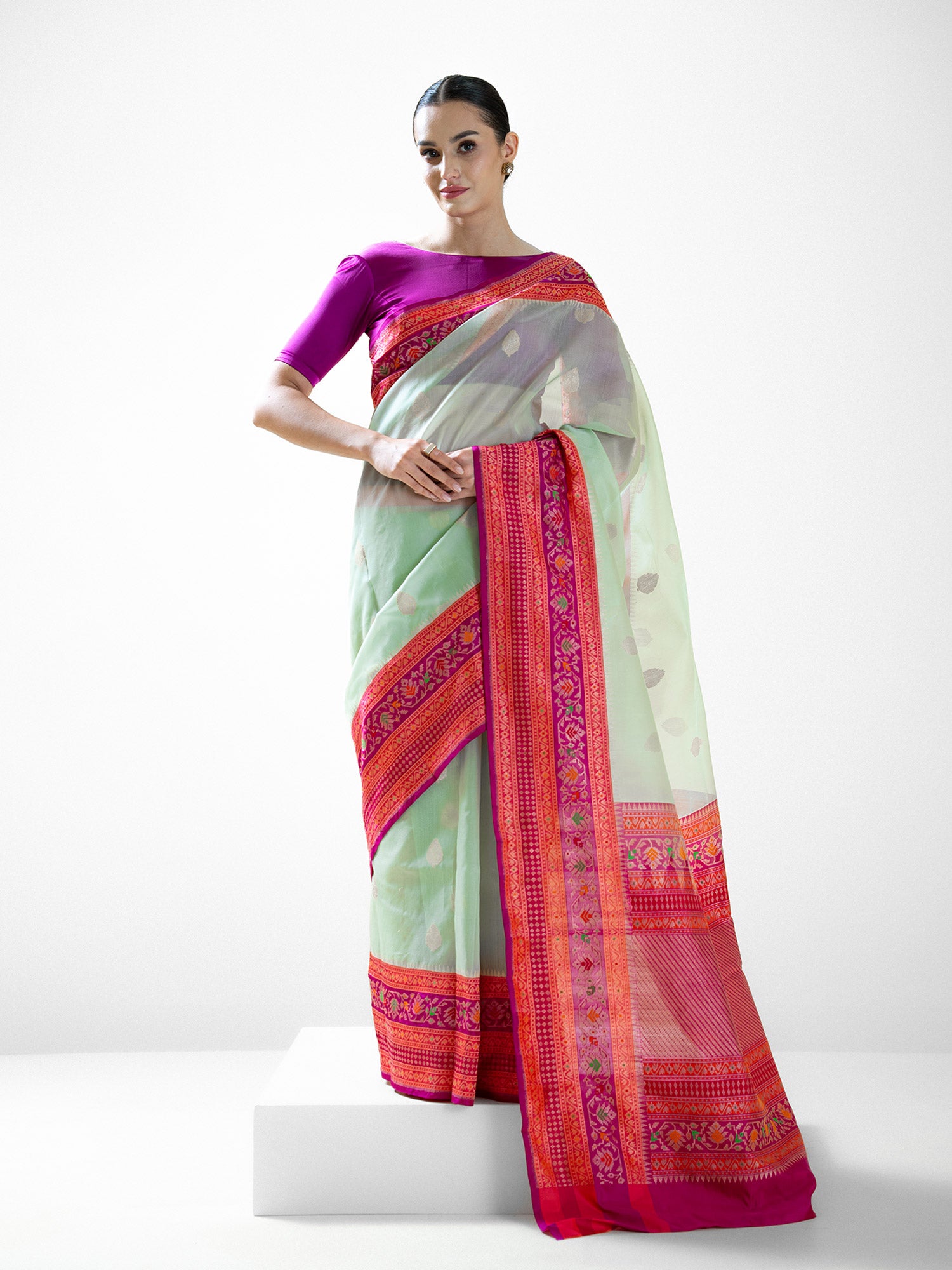
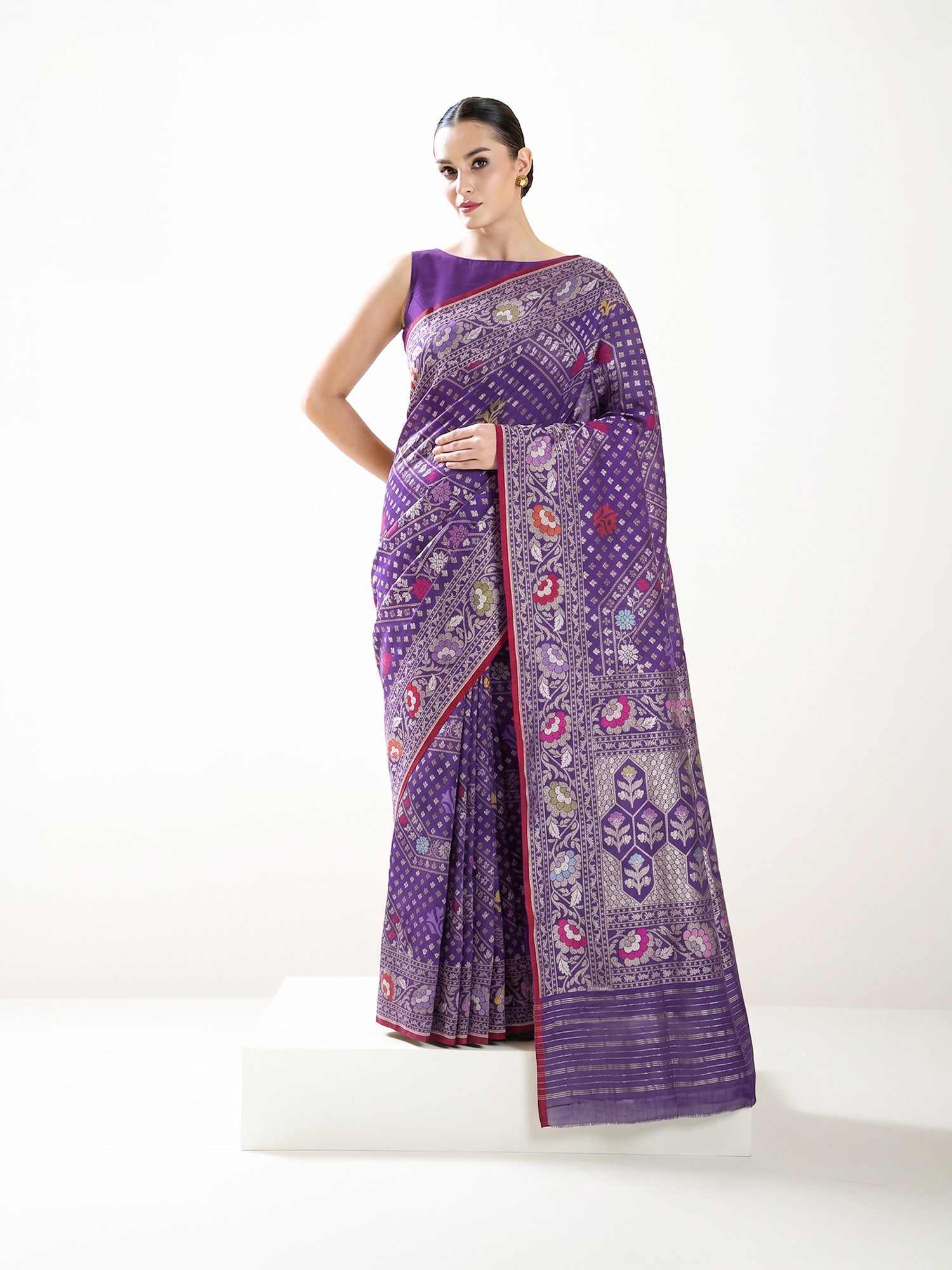


Among the many traditional Banarasi sarees, Meenakari Banarasi Katan Silk holds a special place for its vibrant colours, rich silk texture, intricate motifs, and detailed craftsmanship. It brings together two beautiful elements of Banarasi weaving: the luxurious character of Katan Silk and the colourful artistry of Meenakari.
A Meenakari Katan Silk Saree can look completely different from a plain Katan saree. Instead of relying mainly on zari to create the design, coloured Resham threads are carefully woven into motifs, adding depth, contrast, and multiple shades to the fabric.
This is why a Meenakari Katan Banarasi can look almost like a painting woven into silk.
But there is much more to this saree than its colourful appearance.
How is Meenakari created? Why is Katan Silk considered an excellent base for this work? Which motifs are commonly used? Why do some Meenakari Katan sarees cost ₹50,000 while others can cross ₹2 lakh? And how can you identify an authentic handwoven saree before you buy?
This guide explains the design, craft, value, and buying considerations of a Meenakari Banarasi Katan Saree in simple terms.
Meenakari Banarasi Katan Silk at a Glance
| Feature | Details |
|---|---|
| Fabric | Katan Silk |
| Craft | Meenakari Resham detailing |
| Known For | Multicoloured woven motifs |
| Popular Motifs | Buta, Bel, Kalga, Paisley, Shikargah |
| Common Weaving | Kadwa, Cutwork and other Banarasi methods |
| Best For | Bridal wear, weddings, festive occasions and heirlooms |
| Appearance | Rich, colourful and detailed |
| Price | Depends on silk, weaving, zari, colours, motifs and craftsmanship |
| Premium Combination | Pure Katan + Kadwa + Meenakari + intricate motifs |
The most important point to understand is that Katan Silk is the fabric, while Meenakari is the colourful decorative art incorporated into the woven motifs. They describe two different aspects of the saree.
What Is a Meenakari Banarasi Katan Silk Saree?
A Meenakari Banarasi Katan Silk Saree is a Banarasi saree woven on Katan Silk and enhanced with colourful Resham threads.
Traditional Banarasi sarees often use zari to create decorative motifs and borders. Meenakari adds another layer of colour by introducing carefully selected Resham threads into the motifs.
These threads can create:
-
Flowers
-
Leaves
-
Vines
-
Paisley
-
Birds
-
Animals
-
Mughal-inspired designs
-
Hunting scenes
-
Architectural motifs
The Meenakari is one of the most artistic forms of Banarasi weaving, where coloured Resham threads are carefully woven into floral, Paisley, animal, and ornamental motifs.
When this work is done on Pure Katan Silk, the natural lustre and dense structure of the fabric allow the colours and fine details to stand out beautifully.
This combination is especially popular among brides looking for a rich traditional saree that can become part of their family collection.
What Does Meenakari Mean in a Banarasi Saree?
The word Meenakari has roots in the Persian word “Meena,” associated with enamel and colourful surface decoration.
Historically, Meenakari was associated with jewellery and precious metals, where artisans used vibrant enamel colours to decorate intricate designs.
Over time, this artistic idea became part of Indian craftsmanship, including Banarasi weaving.
But there is an important difference.
Meenakari on jewellery uses enamel.
Meenakari in Banarasi weaving uses coloured Resham threads.
The artisan works with the loom to introduce different coloured silk threads into the woven motifs. This creates a detailed appearance that can look almost painted onto the fabric.
The adaptation transformed Meenakari into one of the admired artistic expressions of Banarasi handloom weaving.
Related guide - Semi Katan Silk vs Pure Katan Silk: What's the Real Difference?
Why Does Meenakari Look So Rich on Katan Silk?
Katan Silk is particularly well suited to intricate Meenakari work because of its rich texture and dense structure.
The silk has a natural lustre that reflects light across the surface. When coloured Resham threads are woven into the motifs, the contrast between the silk base and the colours creates depth.
For example, imagine a deep red Katan Silk saree with:
-
Green leaves
-
Pink flowers
-
Blue details
-
Gold zari
The colours do not simply sit on the surface.
They become part of the woven design.
This is what gives a Meenakari Katan Silk Saree its distinctive richness.
The dense Katan Silk comfortably accommodates highly intricate motifs such as Shikargah and elaborate Kalga, while allowing rich colour transitions.
Popular Meenakari Motifs on Katan Silk Sarees
The motif is one of the biggest factors that determines the personality and complexity of a Meenakari Katan saree.
Buta
Buta is one of the oldest and most recognisable Banarasi motifs.
 Purple Meenakari Boota Katan Silk Handloom Banarasi Saree
It usually represents floral beauty inspired by nature.
When colourful Resham is added, every flower and leaf can become more vibrant and detailed.
Buta Meenakari Katan sarees are especially suitable for women who want a traditional design without an extremely dense all-over pattern.
Bel
Bel refers to flowing vine-like patterns that can continue across the border or pallu.
Meenakari adds colour to the flowers, leaves, and other elements within the vine.
This can make the border look particularly rich.
Kalga
Kalga is an ornamental motif associated with Mughal-inspired decorative art.
Its detailed curves and floral elements make it especially suitable for Meenakari work.
When woven on Katan Silk, coloured Resham can highlight individual parts of the design, giving the motif a regal appearance.
Ambi or Paisley
The Ambi, commonly known as Paisley, is a traditional motif that resembles the shape of a mango.
It has been used in Indian textiles for generations and is associated with prosperity, fertility, and abundance.
Meenakari gives the Paisley motif additional depth by introducing multiple colours into the woven design.
Shikargah
Shikargah is one of the most elaborate Banarasi motifs.
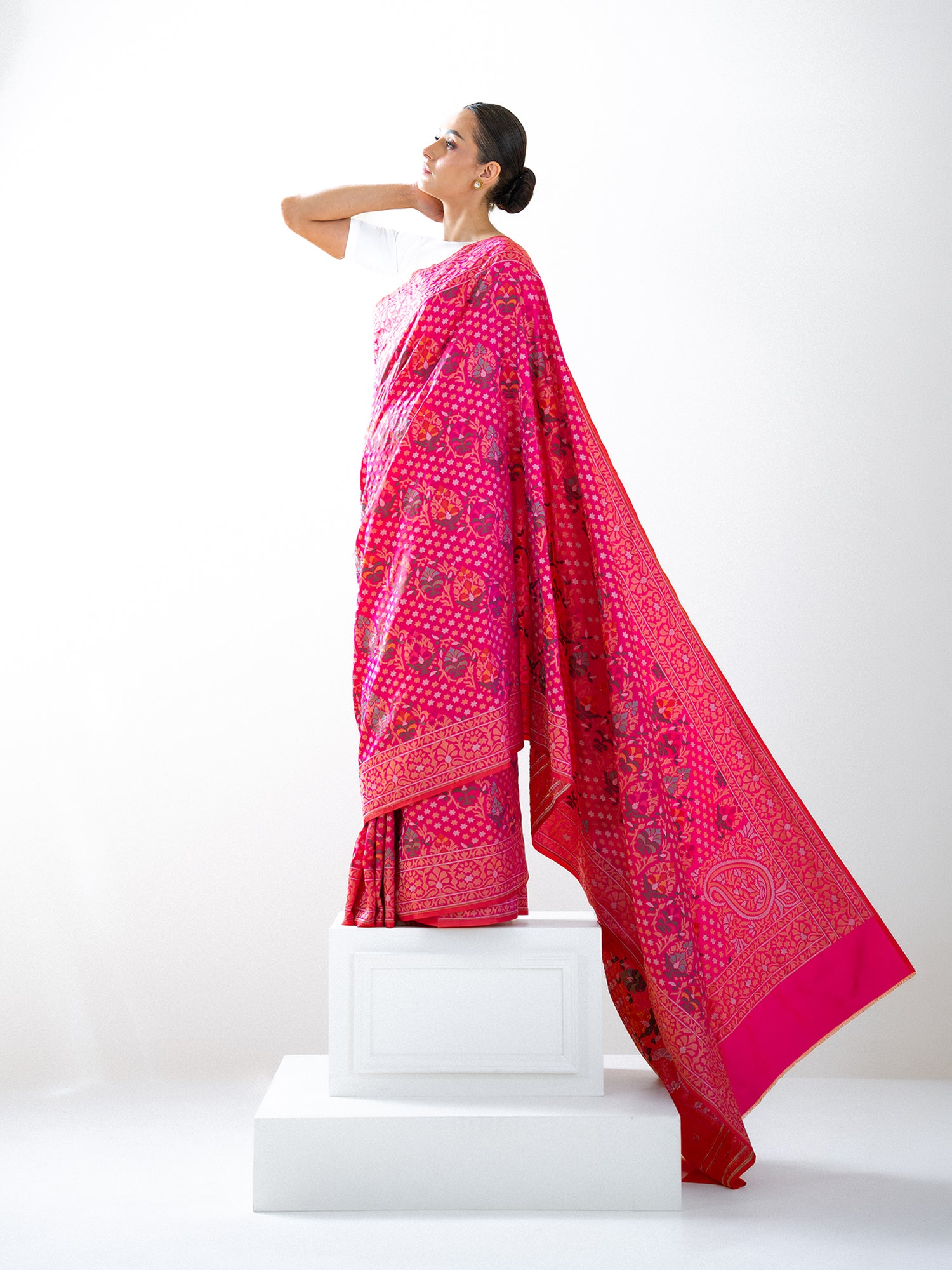
 Dark Pink Shikargah Meenakari Katan Silk Handloom Banarasi Saree
It can feature:
-
Deer
-
Elephants
-
Birds
-
Peacocks
-
Forests
-
Hunters
-
Human figures
-
Royal scenes
Each element requires careful weaving.
When Shikargah is combined with Meenakari and Katan Silk, the result can be an exceptionally detailed and valuable Banarasi saree. The combination is one of the rarest and most valuable expressions of Banarasi craftsmanship.
Related guide - Kadhwa (Kadhua) Weave: Why It Makes Katan Silk Sarees Premium
Meenakari and Kadhwa: A Premium Combination
When you see a Kadhwa Meenakari Katan Silk Saree, you are looking at a combination of two highly skilled aspects of Banarasi craftsmanship.
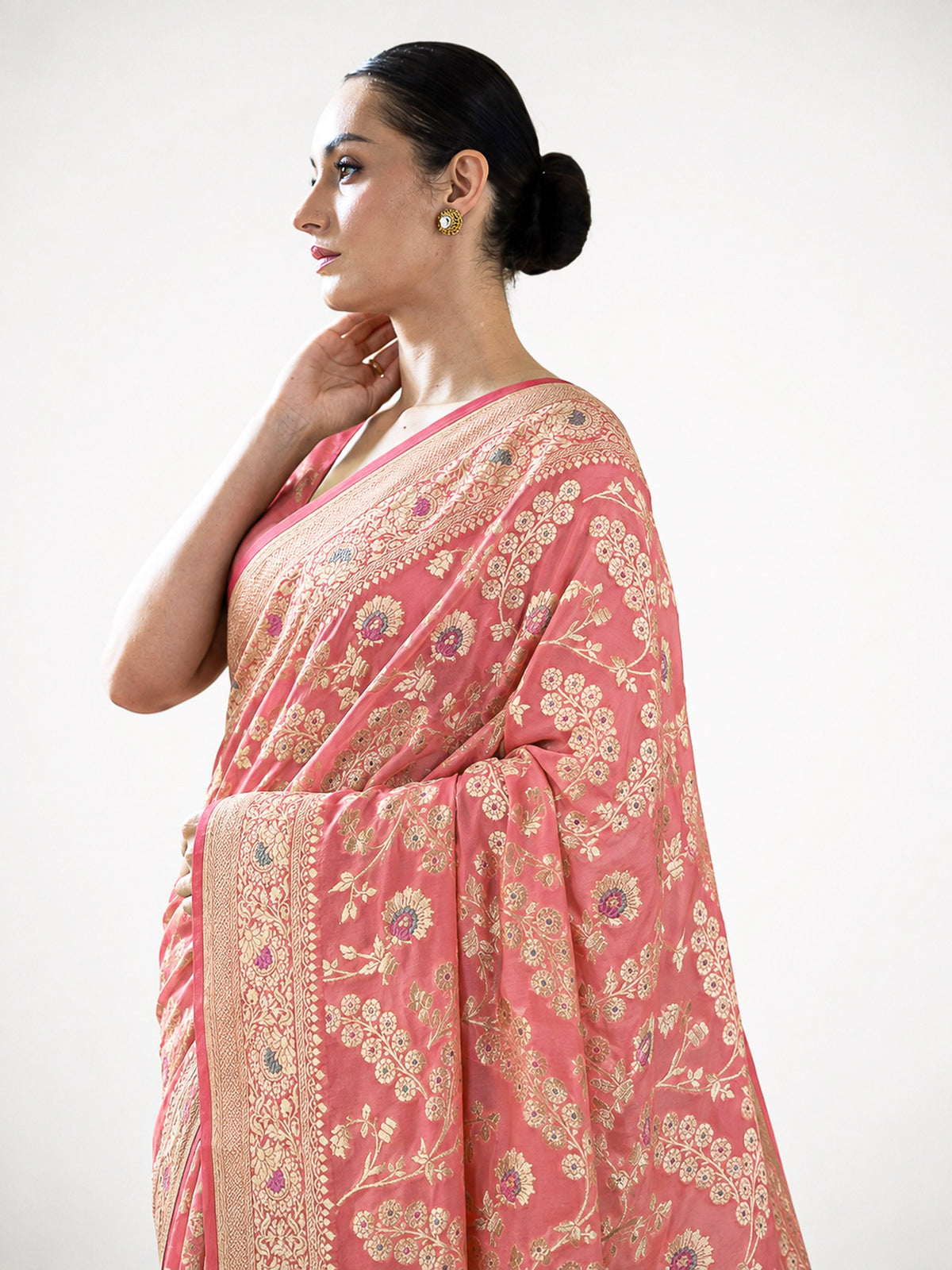
 Pink Meenakari Jaal Katan Silk Handloom Banarasi Saree
Kadhwa is a weaving technique.
Meenakari is the colourful Resham detailing incorporated into the motifs.
Traditional Kadhwa weaving creates individual motifs with significant manual effort, while Meenakari requires the artisan to manage multiple coloured Resham threads accurately.
When the two are combined, the amount of work increases considerably.
The Kadwa Meenakari is significantly more labour-intensive than Cutwork Meenakari and therefore can command considerably higher value.
For buyers looking for a premium bridal Banarasi Katan Silk Saree, this combination can be particularly attractive.
For a deeper understanding, read our related guide: [Kadhwa (Kadhua) Weave: Why It Makes Katan Silk Sarees Premium].
How Many Colours Are Used in Meenakari?
One fascinating part of Meenakari is the number of Resham colours used in the design.
You may hear terms such as:
-
5-colour Meenakari
-
7-colour Meenakari
-
14-colour Meenakari
-
36-colour Meenakari
-
50-colour Meenakari
-
72-colour Meenakari
These numbers refer to the number of Resham colours incorporated into the design. They do not represent separate weaving techniques.
The greater the number of colours, the more colour transitions, planning, precision, and manual effort may be required.
However, the number is not a fixed rule.
A master weaver may use a customised colour combination depending on the design and artistic requirement.
5-Colour Meenakari
Usually creates relatively simple multicoloured floral or decorative motifs.
7-Colour Meenakari
A popular option for elegant floral and traditional designs.
14-Colour Meenakari
Allows greater depth and smoother colour transitions.
36-Colour Meenakari
Can create much more detailed motifs with richer colour variation.
50-Colour Meenakari
Generally associated with highly detailed and complex designs.
72-Colour Meenakari
Represents an exceptionally colour-rich approach and can require significant planning and weaving expertise.
The 72-colour Meenakari combined with premium Katan Silk and highly intricate motifs can form some of the most expensive Banarasi creations.
Why Does a Meenakari Katan Silk Saree Cost More?
This is one of the most important questions buyers ask.
Why can one Meenakari Banarasi saree cost ₹20,000 while another can cost more than ₹1 lakh?
The answer is that price is not determined by Meenakari alone.
It depends on the complete combination of materials and craftsmanship.
1. Pure Katan Silk
Pure Katan Silk generally commands a higher value because of its richness, durability, and ability to support intricate weaving.
2. Weaving Technique
A Kadhwa Meenakari saree requires considerably more labour than a Cutwork Meenakari saree.
3. Handloom Craftsmanship
Authentic handloom weaving involves extensive manual work and gives every saree subtle individuality.
4. Number of Resham Colours
More colours can require greater planning, precision, and weaving time.
5. Motif Complexity
A simple floral Buta requires less work than an elaborate Shikargah scene.
6. Zari Quality
Premium zari can significantly enhance both the appearance and value of the saree.
7. Customisation
A bespoke design can require new planning, colour development, and special loom preparation.
Meenakari Katan Silk Price Range
There is no fixed price for a Meenakari Katan Banarasi.
The price depends on the quality and combination of the elements discussed above.
-
Simpler authentic handloom Meenakari Banarasi sarees may start around ₹15,000–₹45,000.
-
Premium handcrafted sarees using Pure Katan Silk, Kadwa weaving, intricate Meenakari, higher Resham colour counts, and superior zari can generally range between ₹50,000 and ₹1.5 lakh.
-
Highly intricate bespoke pieces using 72-colour Meenakari, Shikargah motifs, premium Katan Silk, and exceptional craftsmanship can exceed ₹2 lakh.
These are broad reference ranges rather than fixed market prices.
A buyer should never assume that a higher price automatically means better craftsmanship.
Instead, evaluate what the price represents.
Is Every Meenakari Katan Saree Handwoven?
No.
Meenakari designs can be produced using different weaving methods, including handloom and powerloom production.
A machine-made saree may reproduce the visual appearance of a traditional Meenakari design, but authentic handloom weaving involves a different level of manual craftsmanship and individuality.
The authentic handloom Meenakari sarees are becoming increasingly rare because fewer artisans continue to specialise in this highly demanding craft, while powerloom production allows much faster and larger-scale production.
This is why buyers should ask specifically:
“Is this saree handwoven?”
Do not assume that an intricate design automatically means handloom.
How Rare Are Authentic Handloom Meenakari Banarasi Sarees?
Authentic handloom Meenakari sarees are becoming increasingly difficult to find because the craft requires specialised knowledge.
An artisan may need to manage multiple coloured Resham threads while keeping every motif aligned.
As the number of colours and motif details increases, the weaving process becomes more demanding.
A premium handloom Meenakari saree may take several weeks or even months depending on:
-
Fabric
-
Weaving technique
-
Motif complexity
-
Number of colours
-
Zari work
-
Overall design
The growing demand for faster production has encouraged greater use of powerlooms, while fewer artisans continue to specialise in traditional handloom Meenakari weaving.
This rarity is part of what gives authentic handloom Meenakari Banarasi sarees their long-term value.
Meenakari Katan Silk for Bridal Wear
A Meenakari Katan Silk Saree is particularly popular among brides because it combines three qualities many brides look for:
Rich silk + traditional Banarasi craftsmanship + colour.
The natural sheen of Katan Silk creates a luxurious foundation, while Meenakari adds vibrant details.
A bride can choose from many design directions.
Traditional Bridal Look
Choose red, maroon, deep green, or rich pink Katan with gold zari and colourful Meenakari motifs.
Royal Bridal Look
Choose royal blue, purple, or deep green with elaborate zari and detailed motifs.
Contemporary Bridal Look
Choose softer pink, sea green, off white, or other modern shades with a traditional Meenakari design.
Heirloom Bridal Look
Choose Pure Katan with Kadwa Meenakari and an intricate motif such as Shikargah or detailed Kalga.
Meenakari on Pure Katan Silk has long been favoured by brides seeking a classic heirloom saree that can be cherished for generations.
Can Meenakari Be Woven on Other Banarasi Fabrics?
Yes.
One common misconception is that Meenakari is exclusive to Katan Silk.
It is not.
Meenakari can be incorporated into:
-
Katan Silk
-
Organza
-
Tissue
-
Georgette
-
Dupion Silk
-
Other traditional Banarasi fabrics
However, the fabric changes how the Meenakari work appears.
| Fabric | Popular Meenakari Motifs | Why It Works |
|---|---|---|
| Katan Silk | Shikargah, Kalga, Buta, Bel | Dense weave supports intricate detailing |
| Organza | Floral Buta, Bel, Paisley | Transparent texture highlights delicate motifs |
| Georgette | Paisley, Floral Buti, Bel | Soft drape complements flowing designs |
| Tissue | Kalga, Bel, Floral motifs | Metallic sheen enhances coloured Resham |
| Dupion Silk | Buta, Paisley, Floral designs | Rich texture gives motifs a bold appearance |
The fabric does not necessarily restrict the motif, but it influences how prominently the Meenakari work is expressed.
This is why Katan Silk is particularly suited to highly detailed Meenakari designs.
Meenakari vs Rangkat: Are They the Same?
No.
Both can create colourful Banarasi sarees, but their artistic approach is different.
Meenakari focuses primarily on enhancing individual motifs using coloured Resham threads.
Rangkat creates colour transitions across the fabric through multicoloured weaving.
| Feature | Meenakari | Rangkat |
|---|---|---|
| Main focus | Multicoloured motifs | Colour transitions across fabric |
| Colour method | Coloured Resham in motifs | Multiple colours woven through fabric |
| Appearance | Detailed colourful motifs | Flowing multicolour effect |
| Popular designs | Buta, Bel, Kalga, Shikargah, Paisley | Floral, geometric and traditional motifs |
| Best for | Brides, festive wear, collectors | Bridal couture, luxury collections, collectors |
Neither is automatically better.
The choice depends on whether you prefer detailed colourful motifs or flowing colour transitions across the saree.
If you want to understand the wider differences, read [Types of Katan Silk Sarees: Jaal, Meenakari, Tanchoi, Shikargah & More].
How to Identify an Authentic Meenakari Banarasi Katan Saree
With the growing popularity of Banarasi sarees, buyers should be careful when purchasing online.
A machine-made saree can sometimes look very similar to a handwoven saree in photographs.
Here are some useful checks.
Check the Fabric
Ask whether the saree is Pure Katan Silk.
If it is being sold as 100% pure silk, ask for appropriate certification.
Check Silk Mark
For pure silk products, Silk Mark certification provides additional confidence regarding silk purity.
Always look for the Silk Mark certification while purchasing pure silk Banarasi sarees.
Ask About Handloom
Ask directly whether the saree is handwoven.
Examine the Meenakari
Look closely at the motif.
Authentic handloom Meenakari can show refined colour transitions, fine motif definition, and detailed weaving precision.
Check the Reverse
The reverse side can provide useful information about how the motifs have been woven.
Ask About the Weaving Technique
Do not simply ask:
“Is this Meenakari?”
Also ask:
“Is it Kadwa Meenakari or Cutwork Meenakari?”
This can make a significant difference to the craftsmanship and price.
Buy From a Trusted Seller
Choose a retailer or manufacturer with clear information about:
-
Fabric
-
Weave
-
Zari
-
Craftsmanship
-
Certifications
-
Care
-
Returns or exchange policies
Always buy from established heritage stores or manufacturers with transparent business practices and expertise in authentic Banarasi weaving.
What Makes a Meenakari Katan Saree Worth the Investment?
A premium saree is not valuable simply because it contains many colours.
Its value comes from the combination of:
Fabric + Weaving + Craftsmanship + Motif + Resham + Zari + Authenticity
For example, a simple Katan saree with a few floral motifs may require significantly less work than a Pure Katan saree featuring:
-
Kadwa weaving
-
72-colour Meenakari
-
Shikargah
-
Fine zari
-
Dense motif work
This explains why two sarees that look similar from a distance can have very different prices.
Always evaluate a Banarasi saree based on its weaving technique, craftsmanship, authenticity, materials, and manufacturer reputation rather than price alone.
How to Choose the Right Meenakari Katan Silk Saree
Before you Buy Banarasi Katan Saree, think about the purpose.
For Bridal Wear
Choose rich Katan Silk with traditional colours, gold zari, Meenakari, and an intricate design.
For Wedding Guests
A lighter Meenakari pattern can offer colour and elegance without appearing overly bridal.
For Receptions
Royal blue, purple, black, sea green, or off white Katan with Meenakari can create a sophisticated appearance.
For Heirloom Collections
Look for Pure Katan, authentic handloom weaving, detailed motifs, and high-quality zari.
For Collectors
Highly intricate Shikargah, Kadwa Meenakari, complex colour combinations, and bespoke designs can be particularly interesting.
For a deeper understanding of Katan's texture and weight, read Is Katan Silk Soft or Stiff? What the Fabric Actually Feels Like.
Why Sacred Weaves Is Relevant for Online Meenakari Shopping
Buying an intricate Meenakari Banarasi Katan Saree online requires confidence in the product information and the seller.
Sacred Weaves, the sister brand of JDS Banaras, offers an online collection of authentic handloom Banarasi sarees, making traditional Banarasi craftsmanship accessible to customers across India and around the world.
For customers who cannot visit Varanasi, an online shopping experience that provides detailed product information and opportunities to understand the fabric and weaving can make the buying process easier.
When purchasing an expensive Katan Silk saree, transparency should always be a priority.
Final Thoughts
A Meenakari Banarasi Katan Silk Saree brings together the richness of Katan Silk and the colourful artistry of traditional Banarasi craftsmanship.
The beauty begins with the silk.
The design comes alive through the weaving.
And Meenakari adds colour, depth, and artistic detail through carefully woven Resham threads.
From simple floral Buta and flowing Bel to ornamental Kalga, elegant Paisley, and highly detailed Shikargah, Meenakari can transform a Katan Silk saree into a remarkable piece of textile art.
When combined with Kadwa weaving, Pure Katan Silk, intricate motifs, multiple Resham colours, and premium zari, the craftsmanship becomes even more demanding—and this is why some Meenakari Katan sarees command a significant premium.
But remember, the highest price does not automatically mean the best saree.
When you shop for a Meenakari Katan Banarasi, look carefully at the fabric, weaving technique, handloom or powerloom production, number of Resham colours, motif complexity, zari quality, authenticity, and seller reputation.
A genuine handwoven Meenakari saree carries something that cannot be measured only in metres of silk or grams of zari.
It carries the time, patience, skill, and knowledge of the artisan.
That is what transforms a beautiful Banarasi Katan Silk Saree into an heirloom.
And when you choose an authentic piece, you are not simply buying luxury clothing. You are helping preserve one of India's most celebrated textile traditions—one carefully woven motif at a time.


