


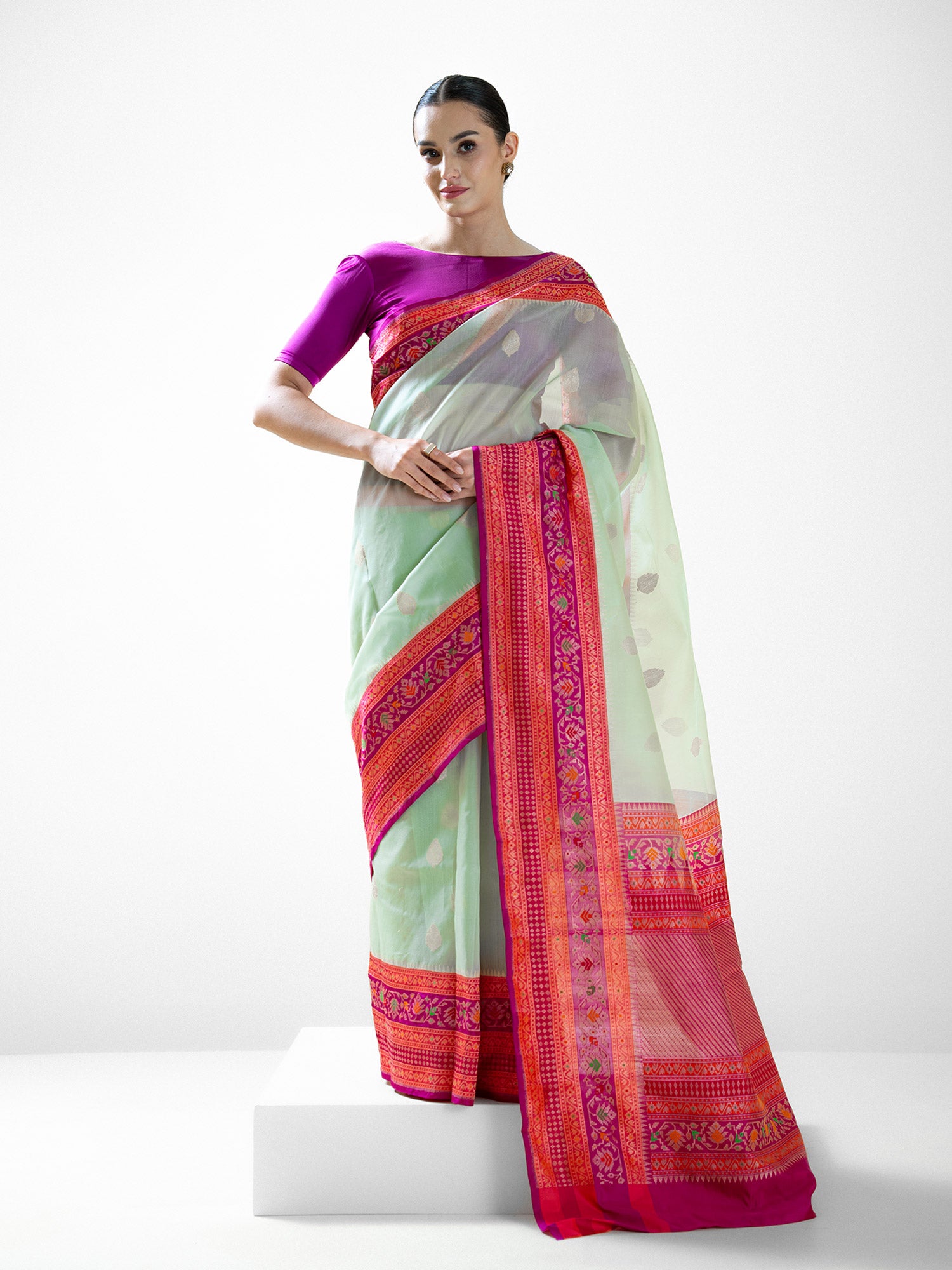
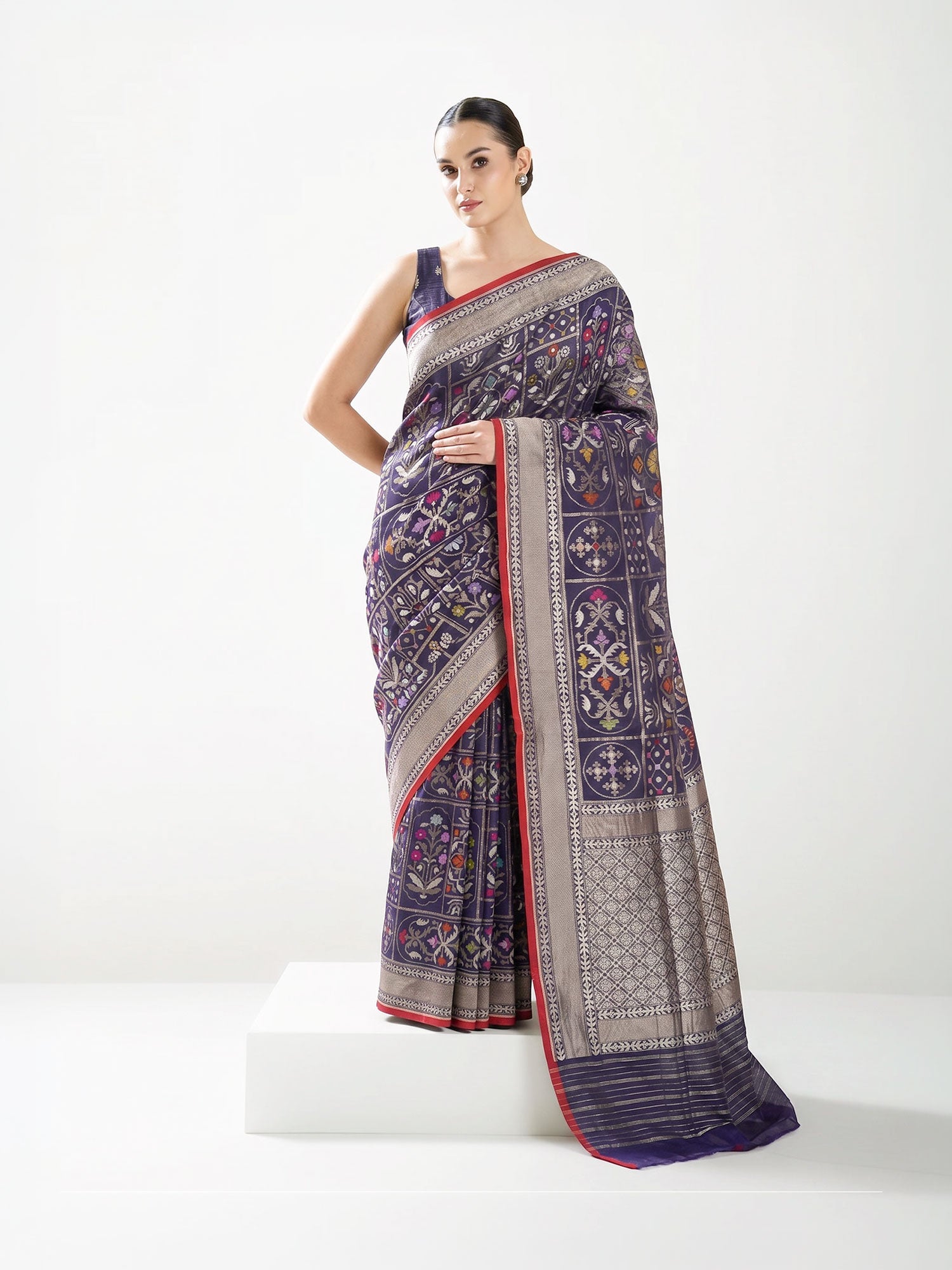


Among the many traditional weaving techniques used in Banarasi sarees, Kadhwa, also written as Kadwa or Kadhua, is one of the most respected and labour-intensive techniques. It is especially admired when used with rich Katan Silk because the dense silk fabric provides an excellent base for intricate motifs, detailed zari work, and fine craftsmanship.
Many buyers see the words Kadhwa Banarasi, Kadhwa Saree, or Kadhwa Silk and immediately associate them with a premium saree. But what actually makes Kadhwa different from ordinary Banarasi weaving? Why are Kadhwa Banarasi Sarees often more expensive? And why is a handwoven Kadhwa Katan saree considered an heirloom?
The answer lies in the way each motif is created.
Unlike simpler weaving methods where extra threads may travel across the back of the fabric, traditional Kadhwa weaving involves creating motifs individually and carefully within the weave. This requires considerable skill, patience, and control over the loom. The result is a saree with exceptional detail, a clean reverse side, and an individuality that is difficult to achieve through mass production.
Kadhwa Banarasi Saree at a Glance
| Feature | Details |
|---|---|
| Weaving tradition | Traditional Banarasi handloom weaving |
| Also written as | Kadhwa, Kadwa, Kadhua |
| Known for | Individually woven motifs and fine craftsmanship |
| Popular fabric | Katan Silk and other Banarasi fabrics |
| Motifs | Buta, Bel, Kalga, Paisley, Shikargah and intricate floral designs |
| Best suited for | Bridal wear, weddings, collectors and heirloom sarees |
| Production time | Depends on motif complexity and weaving technique |
| Value | Influenced by silk quality, weaving, zari, craftsmanship and time |
What Is Kadhwa Weave in Banarasi Sarees?
Kadhwa is a traditional Banarasi weaving technique in which individual motifs are woven carefully into the fabric rather than simply creating the design through a continuous floating thread. This makes the technique highly detailed and labour-intensive.
The artisan has to work carefully on each motif while maintaining the overall balance of the saree. Depending on the design, the process can require extensive planning and many hours of concentrated handloom work.

This is why a Kadhwa Banarasi Saree is valued for more than its visual appearance. The beauty comes from the skill required to create it.
Kadhwa can be used to create small floral Buta, flowing Bel, ornamental Kalga, Paisley motifs, and highly complex compositions such as Shikargah. The more detailed the design, the greater the weaving effort required. The reference content identifies Kadwa as one of the most intricate and prestigious forms of Banarasi craftsmanship.
Related guide - What Is Katan Silk? The Complete Guide to Banarasi Katan Silk Fabric
Is Kadhwa the Same as Kadwa?
Yes, in the Banarasi textile market, you may see different spellings such as Kadhwa, Kadwa, and Kadhua. Buyers may come across all three terms while searching for traditional Banarasi sarees.
The spelling can vary between sellers, textile houses, regions, and English transliterations. What matters more is understanding the weaving method being described.
So, whether you see Kadhwa Banarasi, Kadwa weave Banarasi saree, or Kadhua Banarasi, ask the seller whether the saree is genuinely woven using the traditional individual-motif technique and whether it is handwoven.
Why Is Kadhwa Considered a Premium Weaving Technique?
The premium value of Kadhwa comes from craftsmanship rather than decoration alone.
A saree may look highly detailed, but the technique used to create those details makes a major difference to its value.
Traditional Kadhwa weaving requires:
-
Careful design planning
-
Skilled handloom weaving
-
Individual motif creation
-
Precise thread placement
-
Greater weaving time
-
Experienced artisans
-
Careful finishing
Kadwa weaving is significantly more labour-intensive than Cutwork. In a Kadwa saree, motifs are individually woven by hand, while Cutwork uses a different process and is comparatively faster. -
This difference in labour and craftsmanship is one of the main reasons why an authentic Kadhwa Banarasi can command a premium price.
How Is a Kadhwa Banarasi Saree Made?
Creating a Kadhwa Banarasi Saree is a carefully planned process. The exact workflow can vary according to the design, fabric, and artisan, but the basic process involves several important stages.
1. Design and Motif Planning
Before weaving begins, the motif is carefully designed according to the desired saree pattern.
The artisan or designer decides the placement, size, shape, colours, zari requirements, and overall composition.
For simple floral Buta, the planning may be comparatively straightforward. For elaborate designs such as Shikargah, the planning becomes much more complex. Every element must work together with the saree's border, pallu, and body.
2. Preparing the Silk and Loom
Once the design is finalised, the yarns are prepared for weaving. The warp and weft need to be arranged correctly before the actual weaving starts.
When the saree is woven on Katan Silk, the rich silk base provides a beautiful foundation for detailed motifs and zari.
Katan Silk is particularly suitable for intricate Banarasi motifs because of its rich texture and dense structure.
3. Individual Motif Weaving
This is where the real skill of Kadhwa becomes visible.
Instead of creating the entire pattern through a simpler continuous process, individual motifs are carefully worked into the fabric.
The artisan has to maintain precise control over the design while continuing the main weave.
This requires concentration and experience because even a small mistake can affect the shape, alignment, or balance of the motif.
4. Zari and Resham Detailing
Depending on the saree, Kadhwa weaving can be combined with zari and coloured Resham threads.
This can create highly detailed floral, Mughal-inspired, Paisley, animal, bird, and other traditional motifs.
When Kadhwa is combined with Meenakari, the process becomes even more intricate because the artisan must manage multiple coloured Resham threads within the motif. The reference material specifically notes that combining Meenakari with Kadwa makes the process even more labour-intensive.
5. Finishing and Inspection
After the weaving is complete, the saree is carefully inspected.
Loose threads are checked, the weave is examined, and the saree is finished for presentation.
At this stage, the beauty of the Kadhwa work becomes fully visible.
Related guide - Is Katan Silk Soft or Stiff? What the Fabric Actually Feels Like
Why Does Kadhwa Look Different From Regular Banarasi Weaving?
One of the easiest ways to understand Kadhwa is to look at the back of the saree.
In traditional Kadhwa weaving, individual motifs are created carefully rather than leaving long floating threads running unnecessarily across the reverse side.

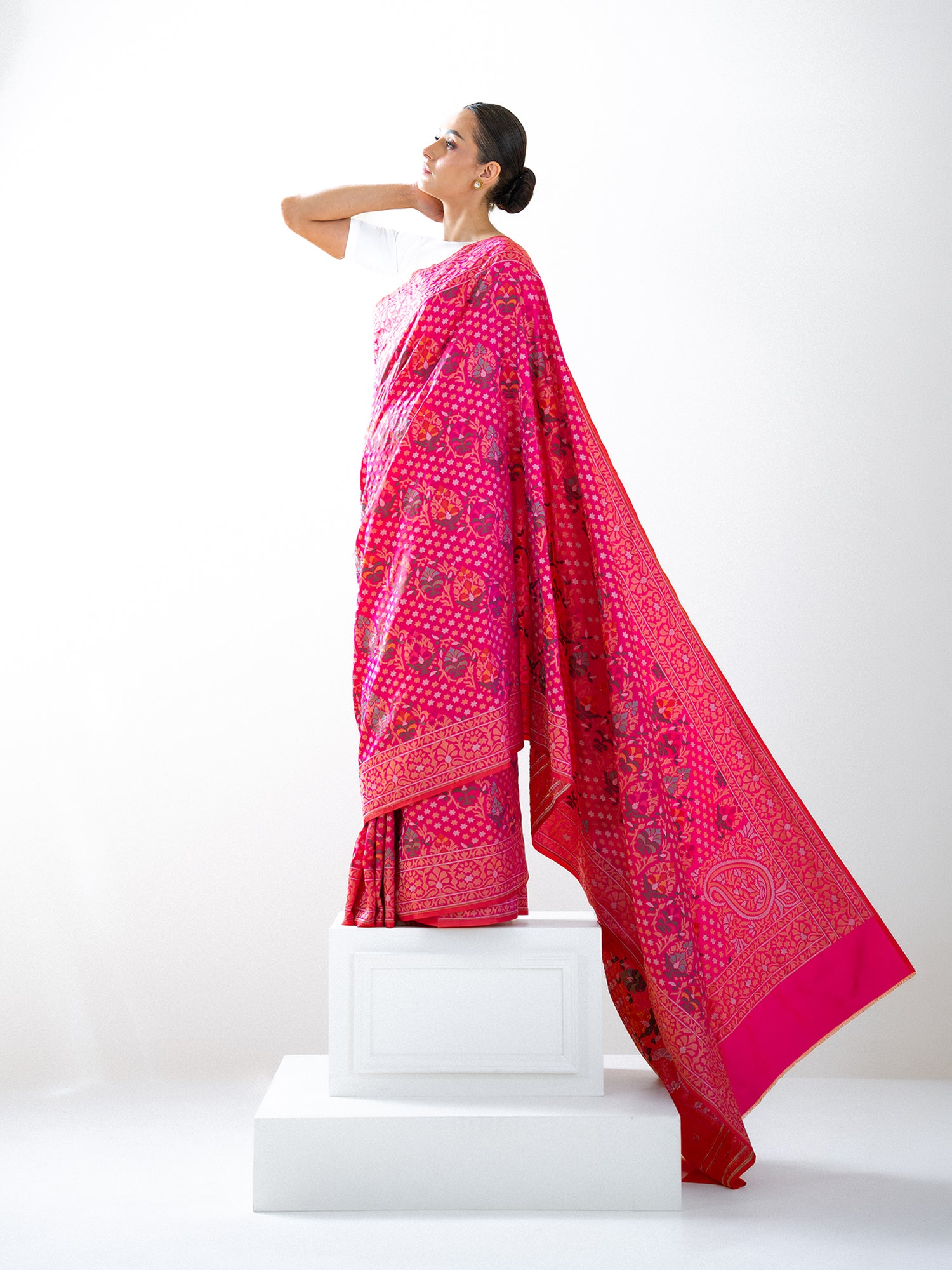
Pink Meenakari Jaal Katan Silk Handloom Banarasi Saree
This can result in a cleaner and more refined reverse appearance.
However, buyers should not try to authenticate a saree based on only one visual feature. Weaving techniques can vary, and modern production methods can imitate traditional appearances.
The better approach is to understand the complete combination of:
weaving technique + fabric + handloom production + craftsmanship + seller authenticity.
Authentic handloom Banarasi sarees should be evaluated by their weaving technique and craftsmanship rather than appearance or price alone.
Why Does Kadhwa Work So Well With Katan Silk?
Katan Silk and Kadhwa weaving are a particularly admired combination.
Katan has a rich texture, natural sheen, and structured drape. These characteristics allow intricate motifs to stand out clearly.
This is especially important for designs that contain many small details.
For example, a Kadhwa Katan saree featuring:
-
Shikargah scenes
-
Detailed Kalga
-
Dense floral Buta
-
Meenakari motifs
-
Elaborate zari can create a rich and regal appearance.
The Katan Silk is one of the most prestigious fabric choices for intricate Banarasi weaving because its rich texture and structured drape allow detailed craftsmanship to remain visually strong.
For women looking for a traditional bridal saree, this combination can be particularly appealing.
Kadhwa Banarasi vs Cutwork Banarasi
Kadhwa and Cutwork are often confused because both can create beautiful and detailed Banarasi designs.

However, they are different weaving techniques.
In traditional Kadhwa, individual motifs are woven by hand. Cutwork uses a different method where the extra threads are cut after weaving.
This difference affects the time, labour, craftsmanship, and price of the saree.
| Feature | Kadhwa Banarasi | Cutwork Banarasi |
|---|---|---|
| Motif creation | Individual motifs woven by hand | Motifs created using Cutwork technique |
| Craftsmanship | Very high | High |
| Production time | Generally longer | Comparatively faster |
| Detail | Exceptional | Excellent |
| Price | Usually premium | Comparatively accessible |
| Best for | Bridal, collectors and heirlooms | Weddings, festive and premium occasion wear |
This does not mean Cutwork is an inferior saree. It simply represents a different balance between craftsmanship, production time, and price.
Kadhwa vs Machine-Made Banarasi Sarees
Modern machines can reproduce complex-looking Banarasi patterns quickly and consistently.
This makes beautiful Banarasi-inspired designs available to a wider range of buyers.
However, machine production cannot fully reproduce the individuality of traditional handloom weaving.
An authentic handwoven Kadhwa saree is naturally individual. Even when two artisans follow the same design, subtle differences can appear because the sarees are created by hand.
These handloom sarees carry an individuality that mass-produced sarees cannot reproduce in exactly the same way.
This individuality is one of the reasons collectors and heritage textile buyers value handwoven Kadhwa sarees.
Which Motifs Look Best in Kadhwa Weaving?
Almost any traditional Banarasi motif can be adapted to Kadhwa weaving, but the technique becomes especially impressive when used for detailed designs.
Buta
Buta refers to individual floral or decorative motifs. Kadhwa allows these motifs to be woven with fine detail and clarity.
Bel
Bel is a flowing vine pattern commonly used along the border and pallu. Kadhwa can give individual flowers and leaves greater definition.
Kalga
Kalga is a traditional ornamental motif with Mughal-inspired characteristics. Its detailed curves and floral elements can make it particularly striking in Kadhwa.
Shikargah
Shikargah is among the most complex Banarasi motifs, featuring hunting scenes with animals, birds, people, forests, and other elements.
Because of its complexity, Kadhwa is particularly suited to this kind of detailed composition.
Related guide - Is Katan Silk Pure Silk? How to Verify Authenticity Before You Buy
Kadhwa Meenakari: When Two Crafts Come Together
One of the most luxurious combinations is Kadhwa Meenakari. It brings together two different aspects of Banarasi craftsmanship.
Kadhwa determines how the motif is woven.
Meenakari adds multiple colours through carefully woven Resham threads.
This distinction is important because Meenakari itself is not a weaving technique. The reference content clearly explains that Kadwa and Cutwork are weaving techniques, while Meenakari is an artistic embellishment that can be incorporated into different weaving methods.
When Kadhwa and Meenakari are combined on Pure Katan Silk, the result can be exceptionally rich.
The natural lustre of silk highlights the coloured Resham work, while the Kadhwa technique provides the detailed structure of the motif.
For women interested in colourful traditional Banarasi sarees, can also help explain how different Banarasi fabrics change the look and feel of a saree.
Why Are Kadhwa Banarasi Sarees Expensive?
One of the most common questions buyers ask is:
“Why does a Kadhwa Banarasi Saree cost more than a similar-looking saree?”
The answer lies in the craftsmanship behind the saree.

Red Jaal Katan Silk Handloom Banarasi Saree
Several factors influence the value.
1. Skilled Handloom Craftsmanship
Kadhwa requires artisans with considerable experience in traditional Banarasi weaving.
2. Time Required
Individual motif weaving takes longer than faster weaving methods. Complex designs can require weeks or months of work depending on the saree.
3. Motif Complexity
A simple floral Buta requires less work than a detailed Shikargah composition.
4. Pure Katan Silk
When premium Katan Silk is used, the material itself contributes to the value of the saree.
5. Zari Quality
The quality of zari affects the appearance and long-term value of a Banarasi saree.
6. Limited Production
Traditional handwoven Kadhwa sarees cannot be produced in the same quantities as machine-made sarees.
This limited production adds to their exclusivity.
7. Heritage Craftsmanship
A handwoven Kadhwa saree represents generations of knowledge passed from one artisan to another.
The value of traditional handwoven Banarasi craftsmanship comes not simply from production time but from the rarity, individuality, and inherited skill involved in creating each saree.
Is Every Kadhwa Banarasi Saree Made on Katan Silk?
No. Kadhwa is a weaving technique, not a fabric. It can be used with different Banarasi fabrics, although Katan Silk is one of the most prestigious and popular choices for premium Kadhwa sarees.
This distinction is important.
Think of it this way:
Katan Silk = fabric
Kadhwa = weaving technique
Banarasi = textile tradition
Therefore, a Banarasi Kadhwa Silk Saree can combine all three: the Banarasi tradition, Kadhwa weaving, and a silk fabric such as Katan.
For buyers who want to understand this relationship in greater detail, read Is Katan Silk Pure Silk? How to Verify Authenticity Before You Buy.
How to Identify an Authentic Kadhwa Banarasi Saree
With the popularity of Banarasi sarees increasing, it is important to know what you are actually buying.
A saree may have a beautiful Kadhwa-like appearance but still be machine-made.
Before purchasing, consider the following:
-
Ask how the saree was woven: This is one of the most important questions.
-
Check whether it is handwoven: Ask for clear information rather than assuming from the design.
-
Examine the reverse side: Traditional Kadhwa generally has a clean and refined reverse compared with methods that leave long floating threads.
-
Check the silk: If the saree is sold as pure silk, ask about its fibre composition and Silk Mark certification where applicable.
-
Look at the motif detailing: Handwoven Kadhwa should show refined and carefully executed motifs.
-
Buy from a trusted source: Choose an established Banarasi manufacturer or heritage retailer with transparent product information.
-
We recommend buying from established heritage stores or manufacturers and checking Silk Mark certification when purchasing a pure silk Banarasi saree.
Why Sacred Weaves Is a Useful Choice for Kadhwa Banarasi Buyers
For buyers who want to explore authentic Banarasi craftsmanship online, Sacred Weaves focuses on traditional Banarasi sarees and provides customers with information about fabric, weaving, and craftsmanship. Sacred Weaves is an online destination offering authentic handloom Banarasi sarees and making traditional Banarasi craftsmanship accessible to customers across India and internationally.
For a premium Kadhwa Banarasi Saree, transparency is particularly important because the weaving technique cannot always be judged from a product photograph. Buyers should be able to ask about the fabric, weaving method, zari, authenticity, and craftsmanship before making an investment.
Expert Insight
One question we encourage every buyer to ask before purchasing a Kadhwa Banarasi saree is:
“How was this saree woven?”
The answer often reveals far more about the saree than its price or appearance.
A Kadhwa saree is valuable because of the skill required to create it. The artisan must control the loom carefully, build individual motifs, maintain design alignment, and complete the saree with precision.
When this craftsmanship is combined with Pure Katan Silk, fine zari, and intricate motifs, the result can become a true Banarasi heirloom.
Which Kadhwa Banarasi Saree Should You Choose?
There is no single “best” Kadhwa saree. Your choice should depend on your occasion, style, budget, and expectations.
| If You Are Looking For… | Consider… |
|---|---|
| Bridal heirloom | Handwoven Kadhwa in Pure Katan Silk |
| Traditional wedding saree | Kadhwa Katan with rich zari |
| Colourful bridal look | Kadhwa Meenakari Katan |
| Collector's piece | Highly intricate Kadhwa Shikargah |
| Festive occasion | Kadhwa with moderate motif density |
| Traditional luxury | Kadhwa Banarasi with detailed pallu |
| More accessible option | Consider Cutwork Banarasi |
Before making your decision, always consider the fabric, weaving technique, handloom or machine production, zari, motif complexity, seller authenticity, and Silk Mark certification where applicable.
For a better understanding of Katan's texture and weight before choosing a heavy Kadhwa saree, read Is Katan Silk Soft or Stiff? What the Fabric Actually Feels Like.
Final Thoughts
A Kadhwa Banarasi Saree is not premium simply because it has a beautiful design.
Its real value lies in the craftsmanship behind that design.
Kadhwa is one of the most intricate traditional Banarasi weaving techniques because individual motifs are carefully woven by skilled artisans. When this technique is combined with rich Katan Silk, detailed zari, Meenakari, or complex motifs such as Shikargah, the result can be one of the finest expressions of Banarasi craftsmanship.
This is why Kadhwa Silk, Kadhwa Katan, and Banarasi Kadhwa Silk Sarees are particularly admired by brides, collectors, and women looking for heirloom-quality sarees.
But before buying, do not judge the saree only by its appearance or price.
-
Ask how it was woven.
-
Check the fabric.
-
Understand the technique.
-
Look at the craftsmanship.
-
Verify authenticity.
When you do this, you are not simply buying a saree. You are understanding the time, patience, skill, and heritage woven into it.
An authentic handwoven Kadhwa Katan saree represents generations of Banarasi weaving knowledge. That is what makes it special—and that is why it can remain a treasured part of a family's textile collection for generations.


